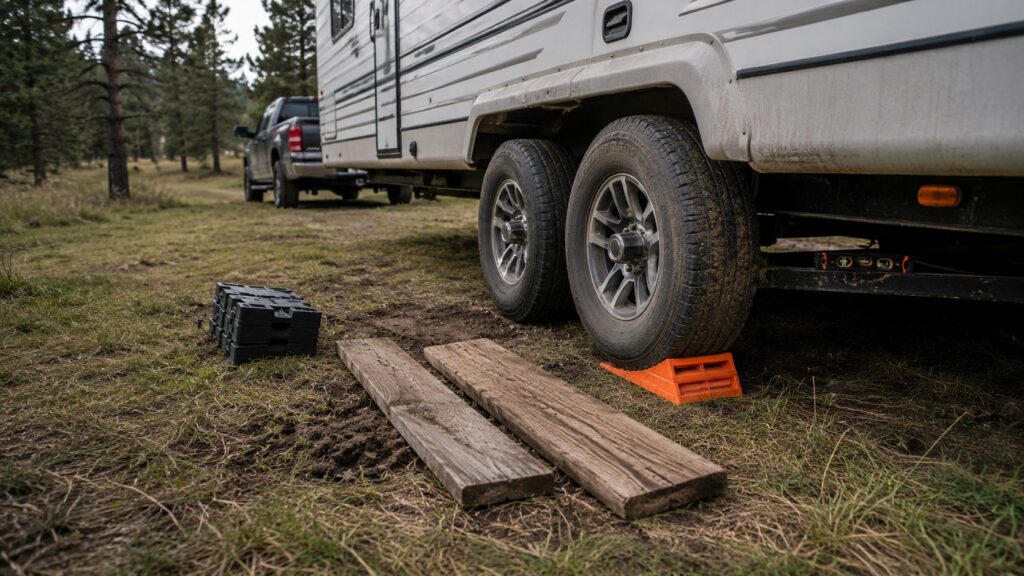
My dad leveled our pop-up with scrap 2x10s he kept under the bunk, cut-offs from some project, gray from twenty Minnesota winters. I still carry lumber in the pass-through, out of respect and because it keeps earning its spot. But since 2020 we’ve owned two travel trailers of our own, and the second one, a 33-footer with a GVWR just shy of 9,600 pounds, has personally destroyed or outgrown most of what the leveling aisle sells.
Five seasons, two trailers, and one emergency Tractor Supply run later, here’s what holds a heavy trailer on real ground, what warps, what soft ground swallows whole, and the one problem with RV leveling blocks that nobody warns you about.
Disclosure: Nomadic Tendency is reader-supported. Links marked “Buy on Amazon” are affiliate links — we may earn a commission at no additional cost to you. We only recommend gear we have personally tested in the field.
Quick verdict: the Andersen Camper Leveler is the best system we’ve run under a heavy tandem-axle trailer, and the reason is chocking, not lifting. Back it up with plastic blocks (Lynx or Camco) sitting on 3/4-inch plywood pads for the spots a curved leveler can’t reach, and keep a couple of cedar boards aboard forever.
Leveling vs. Stabilizing: Settle This First
RV leveling blocks go under your tires and change the trailer’s actual attitude, side to side. Stabilizer jacks only stop the wobble after the trailer is already level. Stabilizers are not lifting equipment: leveling with them is how scissor jacks get bent. Level on blocks first, chock, unhitch, set the tongue jack, then drop stabilizers. The full step-by-step process has its own guide.
Why bother beyond comfortable sleep? Tank sensors lie on a slope. Doors swing themselves shut. An absorption fridge run off-level for days is quietly shortening its own life. And on unimproved ground, where we spend a lot of nights, you’re rarely dealt less than two inches of correction.
How We Got Here (Two Trailers, Five Systems)
We bought our first travel trailer in 2020, a Pioneer BH250 bunkhouse that sat around 6,200 pounds loaded. Before that it was borrowed family RVs, tents, and the occasional cabin splurge. The BH250 is where I tested the old wood-plank method against the first store-bought solution: a set of Camco curved levelers.
At 6,200 pounds they worked on everything but the softest ground. They’re narrow, and that small footprint was the warning sign I didn’t read at the time.
Then we upgraded to the Salem 26DBUD, 33 feet with a 9,595-pound GVWR, and the math changed. The same curved levelers that handled the Pioneer became pavement-only equipment. On anything soft, the extra ton and a half pushed those narrow, honeycomb-bottomed ramps into the ground instead of the trailer up.
So it was back to stacked lumber for a while: cedar 2×6 offcuts from a deck project. Cedar turns out to be the good stuff. It’s about half the weight of the pressure-treated scrap most garages produce, strong enough for the job, and it doesn’t care about rot or cold.
Then came the trip where we forgot the lumber.
Best Overall for Heavy Trailers: Andersen Camper Leveler
Andersen Camper Leveler (2-Pack)
Andersen Hitches✓ Buy on Amazon
The cradle-style leveler we run under our 9,600-GVWR Salem. Continuous adjustment to about 4 inches, wide flat base that resists sinking, and the wheel ends up captured in a cradle chock instead of balanced on a stack.
The Andersen is a curved wedge you back onto until the bubble reads level. Adjustment is continuous from zero to about 4 inches, so there’s no stacking and no guessing. It’s the system we run now, and it fixed the problem that finally made me give up on block stacks altogether. More on that below, because it isn’t the lifting.
Compared to the curved levelers we wore out first, the Andersen is wider, and the bottom is flat instead of honeycombed. That honeycomb pattern is exactly what soft ground grabs. The Andersen’s broad, flat base spreads the load and stays closer to the surface. And because the second piece cradles the wheel as a chock, the tire is captured, not balanced.
Setup at a sloped site went back to being one pass: back in, partner calls the bubble, set the cradle chock, done. The trailer sits in the leveler instead of on it.
What went wrong: nothing structural yet under our 9,600-pound GVWR. Andersen rates the leveler to 30,000 pounds, and unlike the block ratings below, our use so far doesn’t argue with the number. On genuinely soupy ground, physics still applies: anything this side of a snowshoe wants a base under it. The plywood trick below covers that.
Best Blocks, With a Catch: Lynx Levelers vs. Camco Yellow Blocks
Lynx Levelers (10-Pack)
Tri-Lynx✓ Buy on Amazon
The stouter of the two stacking blocks, with the longer reputation under heavy rigs. Under a heavy tandem axle, run them on 3/4-inch plywood pads and treat one 10-pack as a starter kit.
Heavy-Duty Leveling Blocks (10-Pack)
Camco✓ Buy on Amazon
The emergency-run purchase that got us level and then warped under 9,600 pounds of trailer on soft ground. On plywood pads they hold up fine, and they are usually the cheaper buy.
Here’s the emergency-run story. Short trip, lumber forgotten, soft ground, and the curved levelers were swallowed almost immediately. A Tractor Supply happened to be nearby, and I walked out with the classic Camco yellow leveling blocks. The added width did the job. I needed about 2.5 inches of lift, stacked two blocks at 1.5 inches each, and after the trailer settled into the ground we sat level.
Then I pulled off them at the end of the weekend and looked. Heavily stressed, visibly warped. The packaging rates these blocks far beyond our trailer’s weight, but the packaging assumes pavement. Concentrate roughly 2,400 pounds of tandem-axle corner (our GVWR divided four ways, so treat it as an estimate) onto a block sitting on dirt, and the plastic tells you the truth.
The fix, verified on later trips: a 3/4-inch plywood pad under the stack stops the warping entirely. A square of plywood per side turns a dinner-plate footprint back into a snowshoe. With plywood underneath, both the Camco blocks and the Lynx Levelers become a legitimately solid system under a heavy trailer.
Between the two: the Camcos are the cheaper buy and did survive, deformed but serviceable, while the Lynx blocks are the stouter molding with the longer reputation under heavy rigs. On plywood, either works. Without plywood, neither belongs under 9,500 pounds on soft ground. If you’re buying fresh for a big trailer, buy whichever is cheaper that week and spend the difference at the lumber yard.
Fair warning on quantity: a tandem axle means two tires per side, and both need support. One 10-pack builds ramps for one side if you’re lucky, and levels everything only if you camp on pavement. We treat a single pack as a starter kit.
The Free Option That Never Left: Lumber
Cedar 2×6 offcuts, 18 to 24 inches long, doubled up. Lumber won’t give you four inches of lift, but cedar is light, rot-resistant, and indifferent to cold, point loads, and five years in a wet pass-through. Wood never warps into a banana under a tandem axle, and it moonlights as jack pads and as the base layer under everything else on this page.
Forty years after my dad’s gray cut-offs, wood is still on the roster. It just got promoted to supporting cast.
The One We Outgrew: Camco Curved Levelers
Curved Leveler with Chock
Camco✓ Buy on Amazon
The budget curved ramp that served our 6,200-pound Pioneer well on firm ground. Narrow footprint and a honeycomb bottom that soft ground grabs; under our heavier Salem it became pavement-only equipment.
Not a bad product, a mismatched one. Under our 6,200-pound Pioneer they worked on all but the softest ground, and if you tow something in that weight class, they’re a reasonable budget ramp. Under the 9,600-GVWR Salem they became pavement-only: too narrow, with a honeycomb bottom that prints itself into soft earth like a waffle iron. Know your loaded weight before you buy. There’s a line somewhere in the mid-6,000s where these stop being a value and start being a thing you dig out of the mud.
The Problem Nobody Warns You About: Chocking on Blocks
This is my biggest complaint with every stack-style block, and it’s the real reason we moved to the Andersen. Not the lifting. The securing.
When one side of your trailer sits on stacked blocks on uneven ground, the raised-side wheels have nothing honest to chock against. The chock wants flat ground, and the tire is perched on a plastic step above it. You end up wedging chocks at odd angles on the low side and trusting the stack on the high side, with 9,000-plus pounds and your family sleeping inside. It never failed us. It also never felt finished.
The cradle-style leveler solves this structurally. The wheel sits in a curve with a chock locking the other side, so the leveling surface and the chocking surface are the same piece. Back in, cradle it, sleep through the thunderstorm.
RV Leveling Blocks Compared
| System | Type | Max lift | Soft ground | Chocking | Best for |
|---|---|---|---|---|---|
| Andersen Camper Leveler | Curved cradle | ~4″ | Wide flat base; add plywood in soup | Built-in cradle chock | Heavy trailers, 7,500 lbs and up |
| Lynx Levelers | Stacking blocks | ~4″ stacked | Needs plywood pad | Awkward on stacks | Backup geometry, any trailer with plywood |
| Camco Yellow Blocks | Stacking blocks | ~3″ stacked | Warps without plywood | Awkward on stacks | Budget blocks, plywood required |
| Camco Curved Leveler | Curved ramp | ~4″ | Honeycomb bottom sinks | Separate chock | Trailers under ~6,500 lbs |
| Cedar lumber | Planks | ~1.5–3″ | Best footprint per dollar | Normal chocking | Everyone, always aboard |
Who This Is For, and Who Should Skip It
Towing 7,500 pounds or more and camping off pavement: Andersen plus plywood pads, with lumber riding along. This is our setup and I’d rebuy all of it.
Towing under roughly 6,500 pounds: the Camco curved levelers we outgrew are honestly your budget pick. Our complaints are heavy-trailer complaints.
Pavement and gravel-pad campers: any 10-pack of RV leveling blocks plus your tongue jack covers you. Put the savings toward a power station that runs the fridge.
Skip everything here if your rig auto-levels. Enjoy that. Wave as you pass.
FAQ
Can you level an RV with stabilizer jacks?
No. Stabilizer jacks are designed to stop movement in a trailer that’s already level, not to lift it. Using them to raise the frame bends the jacks and can twist the mounting points. Level side-to-side with blocks or ramps under the tires first, then extend stabilizers until they’re snug.
How many RV leveling blocks do I need for a tandem-axle trailer?
Plan on two 10-packs. Both tires on the low side need support, and a 2-inch correction means building two ramps of stacked blocks side by side. A single 10-pack covers single-axle trailers and pavement-pad touch-ups, but under a tandem axle it runs out fast.
What do you put under leveling blocks on soft ground?
A 3/4-inch plywood pad, roughly 12 inches square, under each stack. The plywood spreads the tire’s point load across a wider footprint, which stops the blocks from sinking into soft ground and stops the plastic from warping under heavy trailers. We verified this after warping a set of blocks without it.
Verdict
The Andersen comes out at every soft or sloped site and has made leveling a one-pass job again. The blocks come out when the geometry gets weird, always on plywood now. The cedar comes out every single trip, one way or another.
Somewhere my dad is still leveling a pop-up by eye with scrap wood, getting it close enough. He wasn’t wrong. At 2,800 pounds, close enough is close enough. But the trailers got heavier and the ground got rougher, and I’ve seen what close enough does to plastic, to fridges, and to sleep. Cradle the wheels. Get the bubble flat.
Related: How to Level a Travel Trailer · Boondocking for Beginners · How to Find Dispersed Camping Sites · Free Camping in National Forests