Blackstone 22-Inch Electric Griddle Review: Tested With Real Food
Blackstone 22-inch electric griddle review — heat distribution tested, nonstick coating assessed, compared to propane. Honest verdict after real cooking sessions.
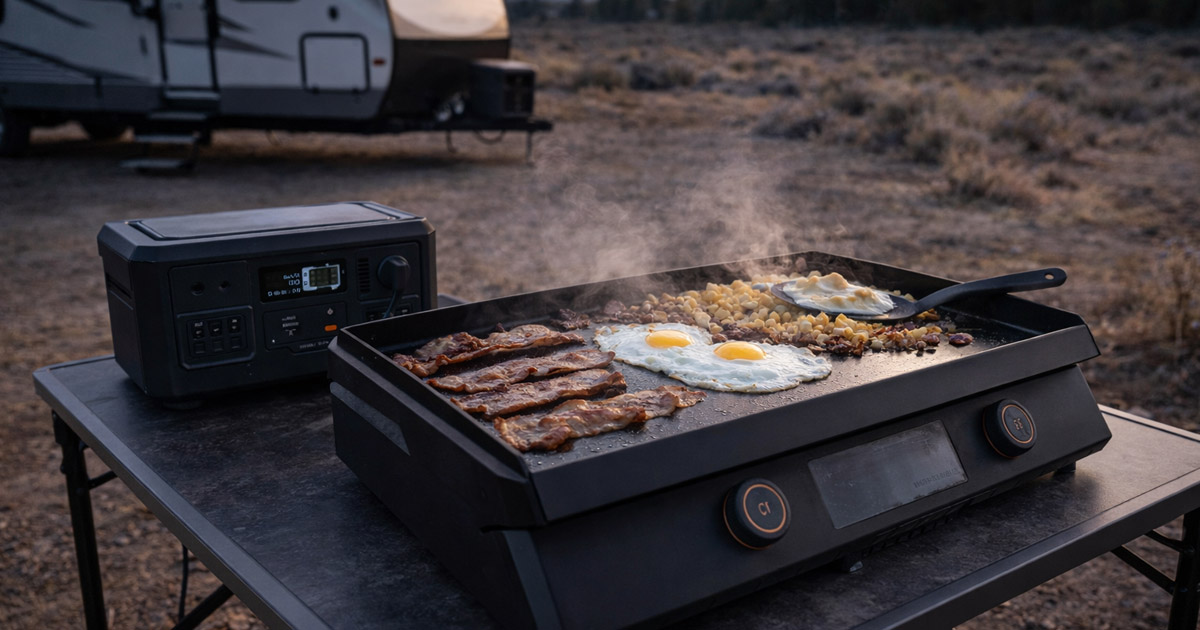
This is a hands-on Blackstone 22-inch electric griddle review after three months of regular use — not a first-impression unboxing. We ran the Blackstone electric griddle through breakfast, smash burgers, and stir fry. We mapped surface temperatures with an infrared thermometer. We used it on the kitchen counter, on the back patio, and at a powered campsite. And we compared it to what most Blackstone buyers already know: the propane models. The verdict isn’t complicated, but the details matter — especially if you’re considering this as an electric griddle for camping or outdoor cooking.
Disclosure: Nomadic Tendency is reader-supported. Links marked "Buy on Amazon" are affiliate links — we may earn a commission at no additional cost to you. We only recommend gear we have personally tested in the field.
Blackstone 22-Inch E-Series Electric Griddle
Blackstone $329 ✓ Buy on AmazonWhat You Get
The Blackstone E-Series electric griddle is a 22-inch tabletop unit with 362 square inches of cooking surface — enough for eight eggs, six burgers, or a full breakfast for four. It’s a single heating zone with a dial temperature control, a ceramic nonstick cooking surface, a removable grease drip tray, and a detachable power cord.
The Blackstone 22 inch griddle weighs roughly 17 pounds, which makes it portable enough to carry to the patio or load into the truck. It draws 1500 watts — standard 15-amp household outlet territory. Some SKUs include a hood; some don’t. Check the specific model before ordering.
What it’s not: this is not the traditional raw steel Blackstone griddle top that you season with oil and build up over years of use. The E-Series uses a ceramic nonstick coating. Different surface, different maintenance, different cooking experience. We’ll get into what that means in practice.
Heat Distribution — The Real Test
Temperature Mapping
We measured surface temperature at nine points across the griddle (3x3 grid — front left, front center, front right, middle row same pattern, back row same pattern) using an infrared thermometer with the dial set to maximum.
The center of the cooking surface reached 475°F. The edges ran cooler — front and back edges averaged 385°F, side edges averaged 400°F. That’s roughly a 90°F difference between the hottest and coolest points. The Blackstone griddle heat distribution follows the pattern you’d expect from a single electric element: hottest in the center, progressively cooler toward the edges.
Time to max temperature from cold: approximately 10 minutes. The element cycles on and off to maintain temperature — Blackstone griddle temperature control is managed by a simple thermostat, not a PID controller. You’ll see the indicator light cycle as it regulates.
What this means in practice: the center is your searing zone. The edges are your warming zone. Once you understand the heat map, you use it — eggs on the edge where they won’t scorch, burgers in the center where they’ll sear. It’s not a flaw. It’s a cooking tool you learn to work with.
Cooking Performance
Breakfast test. Eggs, bacon, and pancakes running simultaneously. The eggs went on the cooler edges — cooked evenly without browning too fast. Bacon in the center — good render, solid crispness. Pancakes across the middle — even browning in the center two-thirds, slightly pale on the outer inch. A full breakfast for three cooked in one pass without shuffling food around excessively.
Smash burger test. This is where you feel the electric vs propane difference. Cold ground beef patties on the center of the hot surface — the temperature dropped and took about 90 seconds to recover to searing temperature. A propane Blackstone recovers in 20–30 seconds. The smash burgers turned out fine — good crust, cooked through — but you’re working with less thermal mass than propane. Cook in smaller batches (four patties, not eight) and the results are solid.
Stir fry test. Mixed vegetables at high heat. The griddle handled it, but “stir fry” is generous — it’s more like “griddle sautéing.” True wok-level heat isn’t happening at 1500 watts. The vegetables cooked, picked up some color, and tasted good. But if you’re expecting blistered snap peas and wok hei, the propane griddle or an actual wok on a gas burner is the tool for the job.
The bottom line on performance: the Blackstone electric griddle cooks real food well. It’s not a restaurant flattop. It’s a solid home and patio griddle that does breakfast and burgers better than it does high-heat searing.
The Nonstick Coating — How It Holds Up
The Blackstone E-Series uses a ceramic nonstick coating — and this is the biggest departure from the traditional Blackstone experience. If you’re used to a seasoned raw steel griddle top, the ceramic surface feels different. Slicker out of the box, easier to clean, and no seasoning process required.
First use: eggs slid freely with a thin layer of oil. The Blackstone griddle nonstick coating works as advertised out of the box. No sticking, no residue, easy wipe-down.
After 20+ cooking sessions: the coating shows minor discoloration in the center (the hottest zone) but no degradation in nonstick performance yet. We haven’t experienced sticking. The surface still cleans with a damp cloth and a light scrub with a non-abrasive pad.
The trade-off is longevity. Ceramic nonstick coatings degrade over time — typically 1–2 years of regular use before the nonstick properties start to diminish. A seasoned raw steel Blackstone lasts indefinitely if maintained. You’re trading long-term durability for day-one convenience. Whether that trade-off works for you depends on how you feel about seasoning maintenance.
One thing to be clear about: you cannot season a ceramic-coated griddle the way you season raw steel. Don’t try. The oil won’t polymerize onto the ceramic surface the way it does on steel. It’ll just make a sticky mess.
Electric vs Propane — The Comparison That Matters
If you already own or have used a propane Blackstone, this is the section that matters. The Blackstone electric vs propane question has a straightforward answer: they’re different tools for different situations.
Heat output. Propane wins. A two-burner propane Blackstone puts out 24,000+ BTUs and recovers temperature almost instantly when cold food hits the surface. The electric tops at 1500 watts (~5,100 BTU equivalent) and takes 60–90 seconds to recover. For high-heat searing and large-batch cooking, propane is meaningfully better.
Wind resistance. Electric wins, and it’s not close. Propane griddles lose significant heat in wind — the flame gets disrupted, the surface temperature drops, cook times increase. The electric element is sealed under the griddle surface and doesn’t care about wind at all. For patio and outdoor cooking in anything beyond calm conditions, the electric griddle delivers more consistent results.
Portability and convenience. Electric requires a power outlet and a cord. Propane requires a tank and an open-air location. For home use, a covered patio, or a powered campsite, electric is simpler — plug in and cook. For tailgating, beach cooking, or any location without power, propane is the only option.
Surface. Traditional propane Blackstones have raw steel that you season and maintain. The E-Series has ceramic nonstick. The steel surface develops better searing character over time and lasts longer. The ceramic surface is easier to use and clean from day one. Different cooking experiences, different maintenance expectations.
Cost per use. Electricity costs roughly $0.10–0.15 per hour at 1500W (depending on your local rates). A 1-lb propane cylinder costs $4–6 and lasts 1–2 hours of cooking. Over hundreds of uses, the electric griddle is significantly cheaper to operate.
Neither is better. The propane Blackstone is a more powerful outdoor cooking tool. The Blackstone electric griddle is a more convenient indoor/outdoor option that trades peak performance for ease of use.
Can You Use It for Camping?
We tested the Blackstone electric griddle at a powered campsite with a standard 20-amp outlet — worked perfectly. Plug in, heat up, cook. Same experience as the back patio. For RV parks and campgrounds with electrical hookups, this is a legitimate campsite cooking option.
The dispersed camping question is more nuanced. We ran it off a 2000W portable power station with a 1500Wh battery. At full draw (1500W sustained), the power station delivered roughly 55 minutes of cook time before the battery hit 20%. That’s enough for one meal — barely. You’re not cooking breakfast and dinner off one charge.
The honest assessment: the electric griddle for camping works at powered sites. It’s marginal for dispersed camping with a power station — technically possible but impractical for multi-day trips. For off-grid cooking, a propane stove or propane griddle is more practical because the fuel is portable, cheap, and doesn’t require recharging. If you’re new to camping on public land without hookups, see our dispersed camping guide for how the logistics work.
What We’d Change
No product is perfect. Here’s what Blackstone could improve:
Dual heating zones. The single-zone design means one temperature across the entire surface. A split zone — high and low — would let you sear in one area and warm in another. The propane models with independent burners already solve this.
Higher wattage option. 1500W is the household outlet ceiling, so Blackstone’s hands are somewhat tied. But a 240V option (like an electric range) for permanent outdoor kitchen installations would open up the heat output significantly.
Longer power cord. The detachable cord is convenient for storage but short for outdoor use. You’ll need an extension cord for most patio and campsite setups.
Replaceable cooking surface. When the ceramic nonstick eventually degrades, you’re looking at replacing the whole unit rather than just the griddle top. A removable, replaceable cooking plate would extend the product’s life.
Larger grease drip tray. The current tray fills up during a greasy cooking session — bacon for four people will max it out. A larger capacity or deeper tray would reduce the mid-cook emptying.
The Verdict
Buy if you want a tabletop electric griddle for home cooking, patio use, or powered campsites. The Blackstone 22 inch griddle heats evenly enough for everyday cooking, the ceramic nonstick surface makes it easy to use and clean, the price is fair for the build quality, and it handles breakfast and burgers well. If your primary use case is a kitchen counter, back patio, or RV park with shore power, this griddle delivers.
Skip if you need a high-heat searing machine, you plan to use it for dispersed camping without electrical hookups, or you want a cooking surface that lasts a decade with proper seasoning. Get the propane Blackstone instead — more heat, more versatility, longer-lasting surface.
The Blackstone E-Series electric griddle is a good product for the right use case. It’s not a replacement for the propane Blackstone. It’s a convenience alternative — simpler to use, easier to clean, cheaper to operate, and better suited to indoor and sheltered outdoor environments. For the price, it does what it promises.
Frequently Asked Questions
Is the Blackstone 22-inch electric griddle worth it?
Yes, for the right use case. It’s a solid tabletop electric griddle for home cooking, patios, and powered campsites. The ceramic nonstick surface makes it easy to use and clean out of the box. It’s not a replacement for a propane Blackstone if you need high-heat searing or plan to cook without an electrical hookup — but for everyday griddle cooking with the convenience of plugging into a wall outlet, it delivers.
How hot does the Blackstone electric griddle get?
The dial goes to approximately 500°F. In our testing with an infrared thermometer, the center of the cooking surface reached 475°F while the edges averaged 385–400°F. It takes roughly 10 minutes to reach max temperature from cold. Hot enough for pancakes, eggs, bacon, and burgers — below what a propane griddle delivers for hard searing or high-heat stir fry.
Is the Blackstone electric griddle good for camping?
It works well at powered campsites and RV parks with shore power — plug in and cook. For dispersed camping or sites without electrical hookups, it’s impractical unless you have a large portable power station (1500W+ continuous output, 1500Wh+ capacity for meaningful cook time). A propane stove or propane griddle is more practical for off-grid cooking.
Blackstone electric vs propane — which is better?
Neither is universally better. Electric is more convenient for home and powered sites, unaffected by wind, cheaper per use, and easier to clean. Propane runs hotter, recovers faster from cold food, works anywhere without an outlet, and the seasoned steel surface lasts longer. Choose based on where you’ll cook most often — if it’s the patio or kitchen, go electric. If it’s tailgating, beach, or dispersed camping, go propane.
Does the Blackstone electric griddle have a nonstick coating?
Yes. The E-Series uses a ceramic nonstick coating, which is different from the traditional raw steel surface on Blackstone’s propane griddles. The ceramic surface is easier to cook on and clean but less durable long-term — expect the coating to degrade over 1–2 years of regular use. You cannot season a ceramic-coated surface the way you season raw steel.
What wattage is the Blackstone electric griddle?
The Blackstone 22-inch E-Series electric griddle is rated at 1500 watts. It draws close to that at full temperature. You need a standard 15-amp household outlet or a power station rated for at least 1500W continuous output. Use 12-gauge outdoor-rated extension cords for runs over 25 feet — lighter cords cause voltage drop and reduce heating performance.