Best Tents for Dispersed Camping: 4-Season vs 3-Season Tested
Best tents for dispersed camping, tested in wind and cold at BLM and forest sites. 3-season vs 4-season compared, plus how to stake on hard ground.
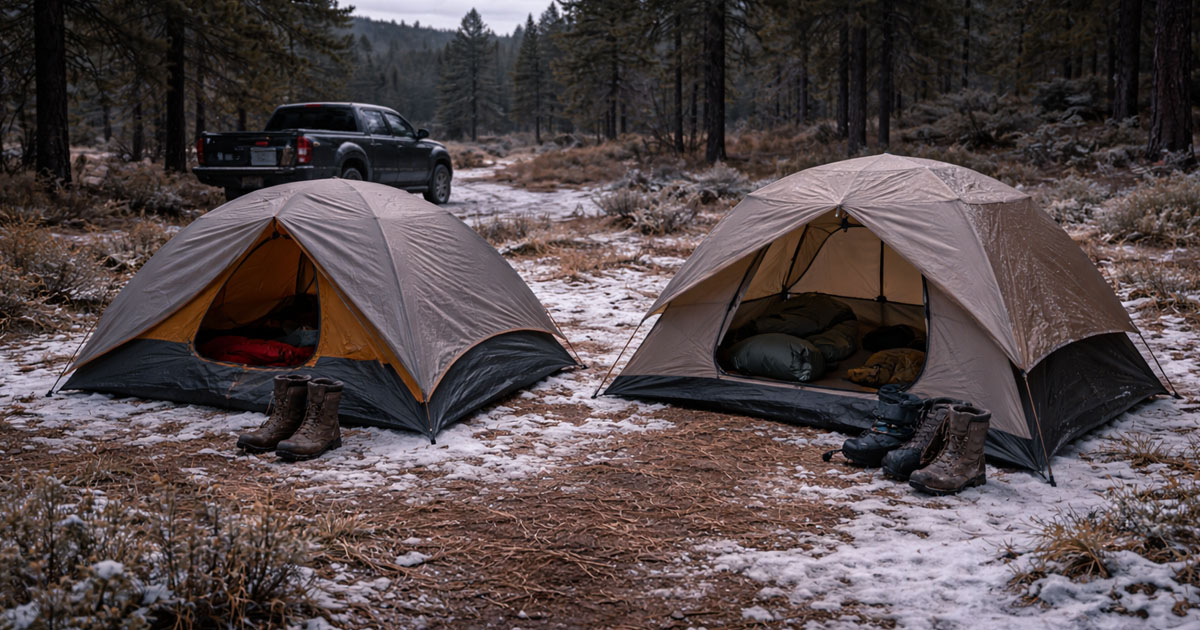
The best tents for dispersed camping have to solve problems that backyard tent reviews never encounter. You’re not setting up on a flat gravel pad with a windbreak of pines. You’re on an exposed BLM ridge in Utah where 30 mph gusts rattle the fly at 2 AM, or a mountain meadow in Colorado where the ground is frozen solid and your stakes bounce off like you’re hammering concrete. Every car camping tent review tests on a lawn. We tested five tents across twelve dispersed camping trips where the conditions were the actual problem — wind on exposed desert sites, hard ground that refuses stakes, cold nights that turn tent walls into condensation chambers, and the question that defines tent shopping for dispersed campers: do you actually need a 4-season tent, or is a good 3-season enough?
If you’re new to dispersed camping, start with our complete dispersed camping guide for the fundamentals. This article is about the shelter decision — what tent holds up when there’s no sheltered campsite to protect it.
Disclosure: Nomadic Tendency is reader-supported. Links marked "Buy on Amazon" are affiliate links — we may earn a commission at no additional cost to you. We only recommend gear we have personally tested in the field.
Quick Picks — Best Tents for Dispersed Camping
- Best Overall (3-Season): REI Co-op Half Dome SL 2+ ($280) — freestanding, survived 35 mph wind, best balance of protection and value
- Best for Cold Weather: Marmot Fortress UL 2P ($420) — 3+ season bridge tent, tested down to 12°F, handles what 3-season tents can’t
- Best Value: Kelty Dirt Motel 2 ($160) — 75% of the performance at half the price, solid first dispersed camping tent
- Best for Wind: NEMO Dagger OSMO 2P ($450) — lowest profile, best wind-shedding design, handled 40+ mph gusts
- Tested and Cut: Coleman Sundome 2-Person ($70) — fiberglass poles failed in 25 mph wind, fly clips popped loose
How We Tested
We tested each tent at actual dispersed camping sites — not on a lawn behind the house. Each test prioritized the conditions that define dispersed camping:
- Wind exposure: set up on exposed BLM ridgelines in Utah’s San Rafael Swell and open meadows in Colorado’s White River National Forest. Left tents up overnight through forecast wind events (25–40+ mph) rather than taking them down
- Hard ground: tested staking systems on desert hardpan, rocky forest floors, and frozen ground. Noted which tents required stakes to stand and which worked freestanding
- Cold nights: temperature range across testing: 12°F to 85°F. Tracked condensation across multiple nights at different temperatures
- Multi-day livability: each tent used for 2–4 consecutive nights to assess interior comfort, gear storage, ventilation, and setup convenience — not one-night impressions
All assessments below are from real dispersed camping use at exposed sites. Your experience at a sheltered campground with flat grass will be better than ours. Your experience on a windy ridge will match.
The Best Tents for Dispersed Camping — Full Reviews
Best Overall (3-Season) — REI Co-op Half Dome SL 2+
REI Co-op Half Dome SL 2+
REI Co-op $280 ✓ Buy on AmazonThe Half Dome SL 2+ is the best camping tent we’ve used for three-season dispersed camping, and it’s the tent we reach for most often. Freestanding design means it stands without stakes — critical on the hard ground and slickrock common at dispersed sites on BLM land. The DAC aluminum poles flex in wind without snapping, and the tent survived 35 mph sustained gusts on an exposed ridge in the San Rafael Swell with no pole failure and no structural issues. Two doors and two vestibules give you gear storage on both sides — we keep boots and packs in one vestibule and cooking gear in the other.
At 5 lbs 5 oz, it’s heavier than ultralight backpacking tents, but you’re driving to dispersed sites — weight isn’t the constraint. The 40-inch peak height lets you sit up comfortably, which matters on a four-day trip when afternoon rain pins you inside. Interior width in the “2+” size gives two adults room to sleep without touching the tent walls, which reduces condensation contact.
The trade-off: Condensation builds on cold nights below 30°F even with both vents open — you’ll wipe the interior with a towel each morning. The fly doesn’t extend to the ground on all sides, so wind-driven rain can angle under the fly and wet the mesh inner. And this is genuinely a 3-season tent — below 20°F, the mesh panels let too much cold air through for comfortable sleeping. For winter dispersed camping, you need more tent than this.
Best for Cold Weather — Marmot Fortress UL 2P
Marmot Fortress UL 2P
Marmot $420 ✓ Buy on AmazonThe Fortress is what Marmot calls a “3+ season” tent, and that designation matters for dispersed campers. It has the pole structure and snow load capacity of a 4-season tent — four DAC Featherlite poles in an intersecting pattern that handles weight and wind — with more ventilation than a true winter mountaineering tent. We’ve used it down to 12°F on a January trip in Colorado with manageable condensation and no structural issues. The full-coverage fly reaches the ground on all sides, blocking wind-driven snow and rain completely.
This is the best tent for cold weather camping at dispersed sites where conditions push past what a standard 3-season handles. Two vestibules, full-length guy-out points on both sides, and enough interior space (88 × 52 inches) for two adults plus gear stashed inside during storms. At 4 lbs 10 oz, it’s lighter than the Half Dome despite the heavier pole structure — the tradeoff is less mesh and more solid fabric, which is exactly what you want in cold weather.
For the full guide on preparing for cold-weather trips, see our article on dispersed camping in winter.
The trade-off: $420 is a serious investment in a tent. In warm weather (above 60°F), the reduced mesh means less airflow — it runs warmer inside than a standard 3-season tent. If you only camp April through September, this tent is overbuilt for your needs. The value case only works if you’re extending into shoulder seasons or winter, where a standard 3-season tent stops being enough.
Best Value — Kelty Dirt Motel 2
Kelty Dirt Motel 2
Kelty $160 ✓ Buy on AmazonThe Dirt Motel is the tent we’d recommend to anyone starting out with dispersed camping. Freestanding, two doors, one vestibule, 42-inch peak height — the tallest interior in our test. The poles are heavier-gauge aluminum (not DAC branded, but sturdy) and handled 25 mph wind on a Colorado forest trip without bending or breaking. The floor fabric is noticeably thicker than most budget tents, which matters when you’re set up on the rocky, stick-covered ground typical of dispersed sites.
At ~$160, it’s half the price of the Half Dome and delivers about 75% of the performance. We used the Dirt Motel as our primary 2 person tent camping shelter for our first year of dispersed camping and never felt underequipped for three-season conditions. It’s available at REI, Amazon, and most outdoor retailers — easy to find, easy to return if it doesn’t fit your vehicle or setup.
The trade-off: At 5 lbs 14 oz, it’s the heaviest tent in our test — not a problem for car camping but worth noting. One vestibule means less gear storage than the two-vestibule tents. Ventilation is adequate but not great — warm nights above 70°F get stuffy with the fly on. And it won’t handle sustained high wind the way the Half Dome or Dagger will — 25 mph was fine, but we wouldn’t trust it in 35+ mph gusts on an exposed ridge.
Best for Wind — NEMO Dagger OSMO 2P
NEMO Dagger OSMO 2P
NEMO $450 ✓ Buy on AmazonThe Dagger is the tent for wind that outperformed everything else in our worst conditions. The hub pole system creates a low, aerodynamic shape that sheds wind rather than catching it like a sail. In our worst wind test — 40+ mph gusts on an exposed Utah ridge that had the Half Dome’s fly flapping and the Kelty’s poles flexing hard — the Dagger flexed gently and recovered, never losing shape. The OSMO fabric resists moisture absorption, which means the fly doesn’t sag when wet and the tent doesn’t gain weight in rain.
Two doors, two vestibules, and a 38-inch peak height. At 3 lbs 5 oz, it’s the lightest tent in our test by a wide margin — designed primarily as a backpacking tent, which means you’re paying for weight savings you don’t need at a car-accessible dispersed site. But the wind performance is real and the build quality is the best we’ve handled.
The trade-off: At ~$450, it’s the most expensive tent in our test. Semi-freestanding design means you need at least two stakes to tension the fly — workable on hard ground with proper stakes but not truly stake-free like the Half Dome or Dirt Motel. The 38-inch peak height is the lowest in our test, which affects sit-up comfort on multi-day trips. If wind isn’t your primary concern, the Half Dome gives you more livability for $170 less.
Tested and Cut — Coleman Sundome 2-Person
We tested the Coleman Sundome ($70) as the budget entry, hoping it would earn a recommendation for occasional campers. On calm nights at a sheltered forest site in Colorado, it was fine — adequate space, reasonable ventilation, easy setup. The problems started when conditions got real.
On a windy night at a BLM site in Utah — 25 mph sustained with higher gusts — two things failed. The fiberglass poles flexed far past their comfort zone, and one pole sleeve tore at a stress point where the pole bent too sharply. The pole was permanently bent after that night. Separately, the fly attaches with plastic clips rather than sleeves or continuous attachment — two clips popped loose in the wind, leaving a section of the mesh inner body exposed to wind-driven dust and grit.
At $70, the Coleman is tempting as a dispersed camping entry point. But fiberglass poles and clip-on fly construction are designed for sheltered campground use, not the exposed conditions that define best tent for BLM land camping. The Kelty Dirt Motel at $160 is the better budget investment — $90 more buys aluminum poles, sleeve fly attachment, and a tent that won’t fail in real wind.
3-Season vs 4-Season — The Decision That Matters
This is the question most dispersed campers get wrong, usually by defaulting to “3-season is fine for everyone.” Sometimes it is. Sometimes it isn’t. Here’s the framework for a 4 season tent vs 3 season decision.
What “Seasons” Actually Mean
3-season tents are designed for spring, summer, and fall — roughly April through October. They use mesh panels for ventilation, lighter pole structures, and handle rain and moderate wind. They’re not designed for snow load or sustained cold below 20°F.
4-season tents are designed for winter and alpine conditions. Full-fabric walls replace mesh, heavier pole structures handle snow load, and full-coverage flies reach the ground. The trade-off: less ventilation in warm weather, more weight, higher cost.
The gap is where most dispersed campers actually live. “3+ season” or “extended season” tents split the difference — more pole structure and fly coverage than 3-season, more ventilation than true 4-season. This is what you need if you’re camping in October through March at moderate elevations, which many dispersed campers do.
When Each Makes Sense for Dispersed Camping
3-season wins when: you camp April through October, stay at lower elevations, do desert BLM trips (even in winter — desert wind is the issue, not snow load), and want to keep costs under $300.
4-season wins when: you camp in winter mountain conditions, consistently face sub-20°F temps, deal with snow accumulation on the tent, or camp at high elevations during shoulder seasons.
3+ season wins when: you want one tent for year-round dispersed camping, you camp October through March at moderate elevations, or you want the safety margin of extra wind and cold protection without the weight and cost of a true mountaineering tent.
Staking on Hard Ground — The Problem Nobody Talks About
At dispersed sites, the ground fights back. Desert hardpan, loose rocky soil, frozen winter ground, and Utah slickrock all refuse standard stakes. Here’s what works:
Freestanding tents are the insurance policy. If stakes won’t hold, a freestanding tent still stands. Weight it with gear bags inside and rocks placed on the corner stake loops. Three of our four recommended tents are freestanding — this is a deliberate priority for dispersed camping.
Rock stacking works when nothing else does. On slickrock in Utah where nothing penetrates the surface, we’ve stacked rocks on the tent’s guy-out loops and stake points. Not elegant, but functional. Make sure to scatter the rocks when you leave — stacked rocks at a campsite signal “someone camped here” and invite more traffic to the spot.
Frozen ground in winter is a different problem. MSR Blizzard stakes — wide, flat aluminum — grip frozen soil better than standard pegs. For ice-hard ground, pre-drill a hole with a knife tip or awl, then set the stake. For the full winter preparation guide, see our article on dispersed camping in winter.
Condensation — Why Your Tent Rains Inside
Tent condensation frustrates every dispersed camper at some point, and exposed sites make it worse. Here’s why it happens and what to do about it.
Condensation forms when warm, moist air — your breathing, your body heat — hits the cold tent walls. It’s physics, not a tent defect. Every tent produces condensation in the right conditions: cold exterior temperature, warm interior, limited airflow. Exposed dispersed sites with no tree canopy get colder faster at night, which means more condensation than sheltered campground sites.
Double-wall tents (mesh inner + rainfly) reduce interior condensation because the air gap between the inner and fly lets moisture migrate outward. Single-wall tents — common in ultralight backpacking — condense directly onto the wall you’re sleeping against.
Open your vents. Even in cold weather, cracking the vents lets moist air escape. The temperature drop is minimal and the dry gear is worth it. We sleep with both vents open in every tent down to about 20°F.
Wipe the interior with a camp towel each morning before packing up. Pack the tent loosely if it’s wet — stuff it rather than rolling it — and dry it at home before long-term storage. Mildew from stored moisture will ruin a tent faster than any wind.
The Bottom Line
The best tent for dispersed camping is the one that handles your worst conditions, not your average ones. For three-season dispersed camping, a freestanding tent with aluminum poles and a full-coverage fly — like the REI Half Dome SL 2+ — handles 90% of what dispersed sites throw at you. For extending into cold weather, the Marmot Fortress UL 2P bridges the gap between 3-season and 4-season without the weight or cost of a mountaineering tent. And for budget-conscious new campers, the Kelty Dirt Motel at $160 is genuinely enough tent for three-season trips.
Before you buy a new tent, spend $20 on real stakes. The tent you already own might be fine at dispersed sites — it’s the stakes and the setup technique that usually fail first. For the rest of your dispersed camping gear setup, see our guides to best coolers for dispersed camping and the complete dispersed camping guide.
Frequently Asked Questions
What is the best tent for dispersed camping?
For three-season dispersed camping, a freestanding tent with aluminum poles and a full-coverage rainfly handles most conditions. The REI Co-op Half Dome SL 2+ ($280) is our top pick — it survived 35 mph wind, sets up without stakes on hard ground, and has enough interior space for multi-day comfort. For cold weather, the Marmot Fortress UL 2P ($420) extends into winter conditions.
Do I need a 4-season tent for dispersed camping?
Most dispersed campers don’t need a true 4-season tent. A quality 3-season tent handles April through October at most dispersed sites. If you camp in winter or shoulder seasons at higher elevations, a 3+ season tent provides extra wind and cold protection without the weight and reduced ventilation of a full 4-season design. True 4-season only makes sense for consistent sub-20°F camping.
What tent is best for wind?
Low-profile tents with strong pole structures perform best in wind. The NEMO Dagger OSMO 2P handled 40+ mph gusts in our testing — its hub pole system creates a wind-shedding shape. For the best balance of wind performance and value, the REI Half Dome SL 2+ survived 35 mph sustained wind with no issues. Avoid tents with fiberglass poles and clip-on flies — they fail in real wind.
How do you stake a tent on hard ground?
Use forged or stamped aluminum stakes (MSR Groundhog or similar) instead of the lightweight stakes that come with most tents — they penetrate hard ground without bending. On rocky ground where stakes won’t hold, use a freestanding tent weighted with gear inside and stack rocks on the guy-out loops. For frozen ground, MSR Blizzard stakes grip better than standard pegs.
What size tent for car camping?
For two people at a dispersed site, a 2+ person tent provides enough room for sleeping plus gear storage inside during rain or wind. The “plus” designation means slightly more floor space than a standard 2-person. A 3-person tent gives more room but takes up more vehicle space. Since you’re driving to the site, weight doesn’t matter — prioritize interior height and vestibule space for livability.
Is a 4-season tent worth it?
A 4-season tent is worth it if you regularly camp in winter conditions below 20°F, in snow, or at high elevations during shoulder seasons. For occasional cold-weather dispersed camping, a 3+ season tent like the Marmot Fortress ($420) provides most of the protection at lower cost and weight. True 4-season tents run $500–$800+ and sacrifice warm-weather ventilation — they’re overbuilt for anyone who primarily camps in three-season conditions.