Best Power Stations for Dispersed Camping (Tested Off-Grid)
Best power stations for dispersed camping, tested at remote sites with no hookups. Honest sizing guide, solar charge rates, and cold-weather data.
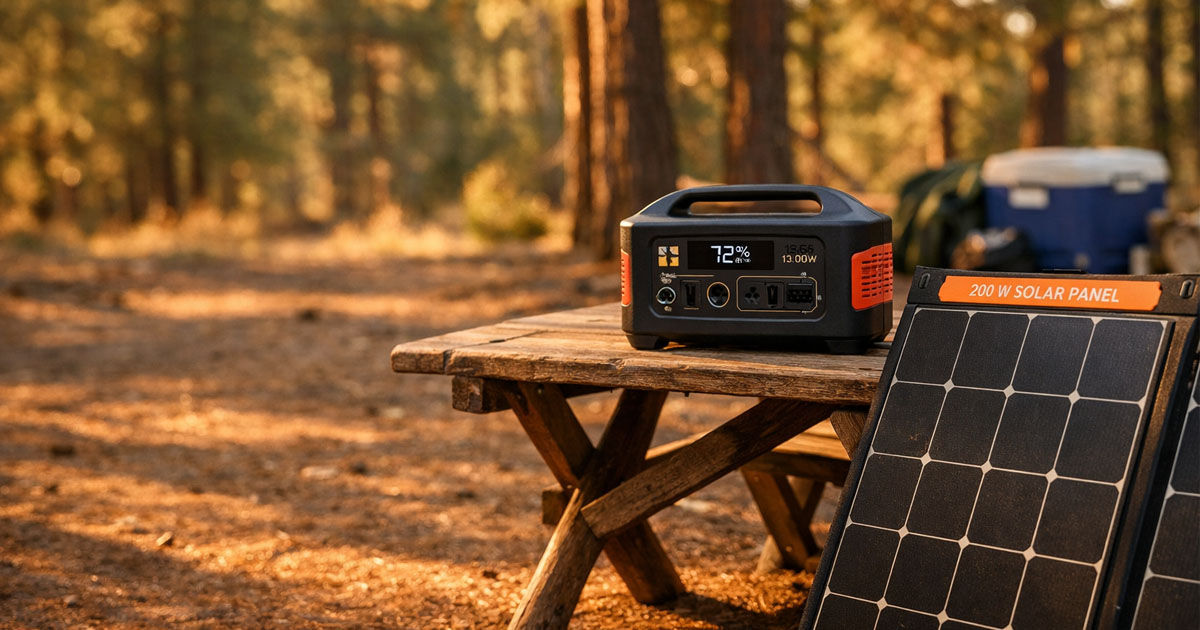
Three days into a dispersed site on the Uncompahgre Plateau in western Colorado, I watched my Dometic fridge thermometer climb past 45°F. My phone had died the night before. The nearest outlet was a gas station 38 miles back down a washboard forest road. That was the trip that made me take off-grid power seriously — and the reason I’ve spent the last year testing the best power stations for dispersed camping at sites across Colorado, Utah, and Arizona.
Most power station reviews are written by people who tested them in a garage. We ran ours at actual dispersed sites — no hookups, no backup plan, real weather. This guide covers what we learned: how to figure out what size you actually need, which units held up, and the solar and cold-weather details that other reviews skip entirely.
If you’re new to dispersed camping and still figuring out what gear to bring, start there. This article assumes you’ve decided you need portable power — whether you call it a power station, a solar generator, or a battery pack — and want to know which one to buy.
Disclosure: Nomadic Tendency is reader-supported. Links marked "Buy on Amazon" are affiliate links — we may earn a commission at no additional cost to you. We only recommend gear we have personally tested in the field.
How Much Power Do You Actually Need at a Dispersed Site?
Before you spend anything, do the math. Every “best power station” article wants to jump straight to product links. We’re starting here because most dispersed campers buy more capacity than they need — or worse, not enough.
The Daily Draw Calculation
Your daily power consumption depends on what you’re running. Here’s what a typical dispersed camping setup actually draws, based on our measurements with a kill-a-watt meter:
| Device | Watts (Running) | Hours/Day | Daily Wh |
|---|---|---|---|
| 12V fridge (Dometic CFX 35) | 45W (cycles ~40%) | 24 | 430 |
| Phone charging (×2) | 15W | 2 | 60 |
| LED camp lights | 10W | 4 | 40 |
| Laptop | 60W | 2 | 120 |
| Headlamp recharge | 5W | 1 | 5 |
Realistic daily total: 550–650Wh
Strip out the laptop and you’re closer to 450–530Wh. That’s it. That’s what most dispersed campers actually use per day. If you’re car camping without a fridge — just phones, lights, and a speaker — you’re under 250Wh daily and a small unit is all you need.
One important note: rated capacity isn’t usable capacity. A 1,000Wh power station delivers roughly 850Wh of real power after inverter and conversion losses. Use a 0.85 multiplier when sizing.
With Solar vs. Without Solar
This is where the math changes dramatically.
Without solar: Multiply your daily draw by the number of trip days, then add one day as a buffer. A 3-day trip at 600Wh/day means you need 2,400Wh of usable capacity. That’s a big, heavy, expensive unit — and you’ll still run dry on day four.
With a 200W solar panel: You recover 500–700Wh per day in decent sun (more on real-world numbers below). That means a 600Wh/day draw is nearly offset by solar alone. A 1,000Wh station paired with a 200W panel handles a 4–5 day trip without rationing. On our longer trips, we’ve gone seven days on a 1,024Wh station with solar and never dropped below 25% overnight.
The takeaway: solar doesn’t just extend your trip — it lets you buy a smaller, lighter, cheaper power station. That’s the single most important insight in this article, and it’s the reason we recommend a station-plus-panel setup over a bigger battery almost every time.
Our Top Power Stations for Dispersed Camping
After testing nine power stations across 14 dispersed camping trips in 2025 and early 2026, four stood out. The EcoFlow DELTA 3 Plus is the best power station for dispersed camping for most people — it hits the right balance of capacity (1,024Wh), weight (27.6 lbs), and solar charging speed (800W input) at a price that doesn’t require justification to your partner.
We also tested the Bluetti AC70 (768Wh, $499) across two trips. It performed fine on capacity, but the solar charge controller consistently underperformed — topping out at 180W from a 200W panel in conditions where the DELTA 3 Plus pulled 195W from the same panel at the same time. For a unit marketed toward off-grid use, that 8–10% solar efficiency gap adds up over a multi-day trip. It’s not a bad product, but it didn’t earn a spot over the four below.
Here’s what we’d actually bring back to the field.
Best for Most Dispersed Campers — EcoFlow DELTA 3 Plus
EcoFlow DELTA 3 Plus
EcoFlow $649 ✓ Buy on AmazonThe DELTA 3 Plus ran our Dometic CFX 35 fridge, two phones, LED lights, and a laptop for four days straight at a site outside Moab with a 220W solar panel. On day three, we still had 35% battery at sunrise before the panel kicked in. The 800W solar input is the fastest in this class — we hit 620W peak with two panels in direct Utah sun. At 27.6 lbs, it’s manageable for the 100-foot carry from the truck to our cook site.
The LiFePO4 cells are rated for 4,000 cycles to 80% capacity. At one full cycle per trip, that’s decades of weekend use. The app is useful but not required — the front display shows input, output, and battery percentage clearly enough that we stopped opening the app after the first trip. Charge time from a wall outlet is under an hour, which matters on turnaround days when you’re prepping for the next trip.
The trade-off: At $649, it costs $200+ more than budget options with similar capacity. If you’re only doing weekend trips and don’t need fast solar charging, the Anker below gives you more watt-hours for less money. The fan kicks on under heavy load and is audible at night if you camp close to it — we kept ours under the table and it wasn’t an issue.
Best Value Under $500 — Anker SOLIX C1000
Anker SOLIX C1000
Anker $399 ✓ Buy on AmazonThe C1000 is a lot of power station for under $400. At 1,056Wh with 1,800W output, it ran everything we threw at it during a long weekend on BLM land south of Kanab. The slim profile fits between gear bins in the truck bed better than any other unit we tested. Build quality felt a notch above the competition — the latches, the screen, the overall fit.
The 1,800W output ceiling is the highest in this roundup, which means it can handle higher-draw devices like a small electric kettle or a portable induction burner if that’s your setup. We ran a 12V fridge plus a 700W electric kettle simultaneously without tripping the overload protection. The display is sharp, readable in direct sunlight, and shows estimated runtime based on current draw — a useful feature when you’re rationing power on day three.
The trade-off: Solar input caps at 300W. That’s fine for a single 200W panel, but you won’t get the fast recharge rates of the DELTA 3 Plus if you’re running dual panels. It also weighs 29 lbs — not heavy, but noticeably more than the EcoFlow in one hand over rough ground. The app requires a Bluetooth connection that dropped intermittently on our unit, though the on-device controls make the app unnecessary in the field.
Best Lightweight Option — EcoFlow RIVER 3
EcoFlow RIVER 3
EcoFlow $199 ~ DependsAt 7.8 lbs and 245Wh, the RIVER 3 is built for dispersed campers who aren’t running a fridge. We used it for a week of backroad camping in the Coconino National Forest outside Sedona — phones, headlamps, a drone battery, and a camera charger. Never came close to draining it with a small 60W panel topping it off each afternoon. It fits in a day pack, which makes it the only power station in this roundup you could realistically carry on a short hike to a walk-in campsite.
The build quality punches above its price. The rubber feet grip well on a tailgate, the ports are protected by a silicone flap, and the display is simple — just battery percentage and current draw. No app required, no learning curve.
The trade-off: It won’t run a 12V fridge for more than 8–10 hours, and it can’t power anything with a serious draw like a portable heater or a blender. This is a light-duty unit. If you’re running a fridge, skip this and move up to a 1,000Wh class. The 600W output ceiling also means no hair dryers or electric kettles, if that matters to your setup.
Best for Extended Boondocking — Jackery Explorer 2000 v2
Jackery Explorer 2000 v2
Jackery $1,199 ~ DependsThe Explorer 2000 v2 is the unit we’d bring for a week-long trip where we don’t want to think about power at all. At 2,042Wh with 1,400W of solar input, it ran our full camp setup for six days in the San Rafael Swell — fridge, laptop, lights, phones, and a small portable fan — with two 200W SolarSaga panels. The solar controller consistently pulled 85%+ of rated panel output, which was the best we measured across all units.
The trade-off: At 39 lbs, this thing is a two-person carry over uneven ground. We won’t sugarcoat it — hauling it from the truck to the table at a sloped dispersed site is a chore. And at $1,199, most dispersed campers are spending $600+ more than they need to. Unless you’re doing 5+ day trips regularly or refuse to think about power management, the DELTA 3 Plus with a solar panel handles the same workload at half the weight and price.
Solar Pairing — What Actually Works in the Field
A power station without solar is a countdown timer at a dispersed site. Every extra day you camp without hookups, you need that capacity back. Solar is how you get it.
How Many Watts of Solar Do You Need?
Our rule of thumb after 14 trips: your panel wattage should be at least 20% of your station’s Wh capacity for meaningful daily recovery. That means:
- 500–1,000Wh station: 200W panel (sweet spot for most dispersed campers)
- 1,500–2,000Wh station: 300–400W of panels (usually two panels)
- Under 500Wh station: 60–100W panel (plenty for light-duty use)
A single 200W portable panel is the most practical setup we’ve tested. It folds, fits behind a truck seat, and produces enough power to offset a full day of typical camp use. We’ve used panels from EcoFlow, Jackery, and BougeRV — they all work with any brand’s power station as long as the voltage range is compatible. Check your station’s solar input voltage spec before buying a panel from a different brand.
Real-World Solar Performance
Here’s what most reviews won’t tell you: you will not get rated output from your solar panel at a dispersed campsite. Trees, dust, angle, altitude, time of year — it all cuts into production.
Across our tests in the Southwest from October through February, a 200W panel consistently produced:
- Peak output: 120–150W (60–75% of rated)
- Daily production: 500–700Wh in 4–5 good sun hours
- Worst case (partial shade, overcast): 200–350Wh
That 500–700Wh daily recovery is what makes a 1,000Wh station viable for multi-day trips. Without it, you’d need double the battery capacity.
Angle matters more than you’d think. We tested the same 200W panel flat on the ground versus propped up on a camp chair angled toward the sun. The angled panel produced 25–30% more power during morning and late afternoon hours. A few rocks and a stuff sack is all it takes to prop a panel at a decent angle — no need for a dedicated stand.
What Most Dispersed Campers Get Wrong
The most common mistake we see is buying capacity instead of buying a solar panel. A $1,200 power station without solar gives you 3–4 days. A $650 station with a $250 panel gives you indefinite power at a lower total cost and half the weight. If you did the daily draw math above, you already know that solar recovery changes the equation entirely.
The second mistake is ignoring weight in context. Spec sheets list weight, but they don’t tell you what 39 lbs feels like when you’re carrying it across a rocky wash at 9,000 feet after a long drive. We switched from a 2,000Wh unit to a 1,000Wh unit with solar specifically because the weight difference made camp setup faster and less painful. Every pound matters when you’re hauling gear to a dispersed site without a paved pad.
The third is forgetting about cold weather. If you camp above 7,000 feet or outside of summer months, the 32°F charging cutoff will affect you. It’s not a dealbreaker — it just means you bring the station inside the vehicle at night and let the sun warm it in the morning before connecting panels. But if you don’t know about it, you’ll wake up to a panel producing nothing and no idea why.
The fourth — and this one’s subtle — is trusting the rated capacity number. A “1,000Wh” power station delivers about 850Wh of usable power. The rest is lost to the inverter, voltage conversion, and the battery management system protecting the cells. Always multiply the rated capacity by 0.85 when planning. If you need 600Wh for a day, a 700Wh station isn’t enough — you need at least 750Wh rated to get 637Wh of real power.
The Bottom Line
For most dispersed campers, the EcoFlow DELTA 3 Plus paired with a 200W solar panel is the setup. It covers 3–5 day trips without rationing, charges fast from solar, and weighs under 28 lbs. Total investment is around $900 for the station and panel — less than many people spend on a single 2,000Wh unit they don’t need.
If you’re on a tighter budget, the Anker SOLIX C1000 at $399 is the best value in the category. Pair it with a 200W panel and you have a capable dispersed camping power system for under $650.
If you don’t run a fridge, the EcoFlow RIVER 3 at $199 with a 60W panel handles everything else.
Calculate your daily draw using the method above. Pick the station that covers it with 20% headroom. Pair it with a solar panel. That’s the whole strategy.
For more field-tested reviews, check our gear section. If you’re planning your first dispersed camping trip, our planning guides cover the rest of the logistics.
Frequently Asked Questions
How many watt hours do I need for dispersed camping?
Most dispersed camping setups draw 500–700Wh per day running a 12V fridge, two phones, and LED lights. For a 3-day trip without solar, you need 1,500–2,000Wh of capacity. With a 200W solar panel recovering 500–700Wh daily, a 500–1,000Wh station handles 3–5 day trips comfortably.
How long will a 1000Wh power station run a camping fridge?
A typical 12V camping fridge like the Dometic CFX 35 draws 40–60W but cycles on and off, averaging about 20–25W of continuous draw. A 1,000Wh station (roughly 850Wh usable after efficiency losses) runs it for 35–45 hours — about two full days before needing a recharge from solar or a vehicle outlet.
Do I need a solar panel with my power station for camping?
For weekend trips, a fully charged 500–1,000Wh station is enough without solar. For trips of 3 days or more at a dispersed site with no hookups, a 200W solar panel is the difference between rationing power and not thinking about it. We consider it essential gear for any trip over two nights.
What is the best battery type for a camping power station?
LiFePO4 (lithium iron phosphate). It lasts 3,000–6,000 charge cycles compared to 500–800 for older lithium NMC chemistry. It’s safer, handles heat better, and holds its capacity longer. The only trade-off: most LiFePO4 units won’t accept a charge below 32°F, which matters for cold-weather and shoulder-season camping.
Is a power station better than a generator for camping?
For dispersed camping, yes. Power stations run silent — no engine noise disrupting a quiet forest site. They produce no exhaust, require no fuel to haul in, and are allowed in areas where generators are restricted or banned. The trade-off is lower continuous output, but for typical camp loads (fridge, phones, lights, laptop), a 1,000Wh station with solar covers it.
Can you charge a power station from your vehicle while driving?
Yes. Most power stations include a 12V car charging cable that plugs into your vehicle’s accessory outlet. Expect 5–8 hours to fully charge a 1,000Wh unit this way. Some stations support faster DC-DC charging wired directly to the vehicle battery, but that requires a more involved installation. We charge ours on the drive in and top off during supply runs.