Best Coolers for Dispersed Camping: Tested Off-Grid, No Power Required
Best coolers for dispersed camping, tested at off-grid sites with no ice resupply. Real ice retention data, budget to premium picks, and management tips that matter more than the cooler.
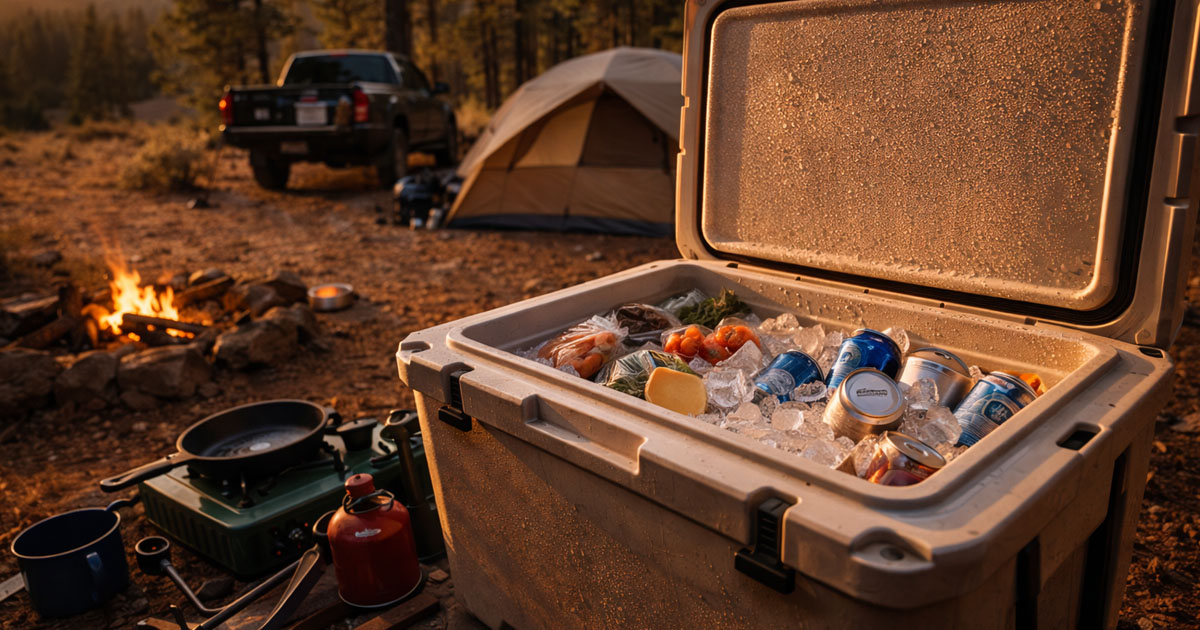
The best coolers for dispersed camping have to solve a problem that backyard reviews never test: you pack ice on day one, drive 40 miles down a dirt road, camp for three to five days, and there’s no gas station to resupply. Your cooler is your refrigeration — no electricity, no backup, no second chance. Every cooler review we’ve read tests with the lid closed in a garage. That’s not camping. At a dispersed site, you open the cooler 6–8 times a day, it sits in direct sun in the truck bed for hours, and it bounces down washboard forest roads that would loosen the latches on half the coolers on the market.
We tested five coolers across nine dispersed camping trips in Utah and Colorado — desert heat and mountain conditions — to find the best camping cooler for people who camp where there’s no power and no ice available. This guide covers what held ice, what didn’t, and the ice management system that matters more than which cooler you buy. If you’re new to dispersed camping, start with our complete dispersed camping guide for the fundamentals.
Disclosure: Nomadic Tendency is reader-supported. Links marked "Buy on Amazon" are affiliate links — we may earn a commission at no additional cost to you. We only recommend gear we have personally tested in the field.
Quick Picks — Best Coolers for Dispersed Camping
- Best Overall: YETI Tundra 45 ($325) — 4.5-day ice retention in mountain testing, IGBC bear-resistant certified, the benchmark
- Best Value: Lifetime 55-Quart High Performance ($130) — 4-day retention, rotomolded, half the price of YETI
- Best Budget: Coleman Xtreme 52-Quart ($40) — 2.5 days, enough for a long weekend, proves you don’t need rotomolded
- Best for Bear Country: YETI Tundra 45 or Grizzly 40 ($280) — both IGBC certified for areas that require it
- Tested and Cut: RTIC 45 QT ($200) — good initial retention, but lid seal degraded after six weeks of dirt road use
How We Tested
We tested each cooler at actual dispersed camping sites — not in a garage. Each test followed the same protocol:
- Identical load: 10 lbs block ice, 5 lbs cubed ice, same food items and drinks in each cooler
- Real camping use: opened 6–8 times per day for meal prep, drinks, and snacks
- Two environments: desert sites in Utah’s San Rafael Swell (90–100°F ambient) and mountain sites in Colorado’s White River National Forest (75–85°F ambient)
- Daily measurement: checked remaining ice and internal temperature at 7 AM and 5 PM
- Road testing: each cooler made the trip down 30+ miles of dirt and washboard road in the truck bed
All retention numbers below are from real camping use, not lid-closed lab conditions. Your results with the lid closed will be longer. Your results with the lid open more often will be shorter. These numbers reflect how a cooler actually performs when you’re living out of it.
The Best Coolers for Dispersed Camping — Full Reviews
Best Overall — YETI Tundra 45
YETI Tundra 45
YETI $325 ✓ Buy on AmazonThe Tundra 45 is the cooler we compare everything else to. In our mountain testing at 80°F ambient, it held usable ice for 4.5 days with 6–8 opens per day. In desert testing at 95°F+, it managed 3 full days — we still had ice on the morning of day 4, but not enough to keep food safely cold. The rotomolded construction is genuinely a cut above: the T-Rex lid latches haven’t loosened after months of dirt road abuse, the rubber gasket seals cleanly every time, and the drain plug has never leaked.
At 23 lbs empty and 26.4 quarts usable capacity, it holds enough food and ice for two people for 4–5 days. IGBC bear-resistant certified — this matters if you’re dispersed camping in grizzly habitat. We’ve used the Tundra 45 as our primary food cooler for six months.
The trade-off: $325 is a lot of money for a box that keeps things cold. The Lifetime 55-Quart matched it to within half a day of ice retention at less than half the price. You’re paying for build quality, the IGBC certification, and the confidence that it’ll still seal properly after three years of rough use. Whether that premium is worth it depends on how often you camp and whether you need bear certification.
Best Value — Lifetime 55-Quart High Performance
Lifetime 55-Quart High Performance
Lifetime $130 ✓ Buy on AmazonThis is the cooler that made us question the rotomolded price premium. In identical testing conditions — same ice load, same opening frequency, same ambient temperature — the Lifetime held ice for 4 days in the mountains and 2.5 days in the desert. That’s half a day behind the YETI in both environments. For a cooler that costs $195 less.
The construction is rotomolded with 2+ inches of insulation. The latches are functional but not as refined as YETI’s — they require more force to close and occasionally need readjustment after rough roads. At 27 lbs empty, it’s 4 lbs heavier than the Tundra 45 with comparable capacity. We’ve been using this as our secondary (drinks) cooler for six months, and it’s held up well. Available at Walmart, which means you can inspect it before buying and return it easily.
The trade-off: Not IGBC bear-resistant certified. If you’re camping in grizzly country where IGBC certification is required, this won’t meet the regulation. The latches are the weak point — functional but they feel like they’ll be the first thing to fail long-term. Heavier than the YETI despite similar capacity.
Best Budget — Coleman Xtreme 52-Quart
Coleman Xtreme 52-Quart
Coleman $40 ✓ Buy on AmazonA $40 cooler in a roundup with a $325 YETI sounds like a joke. It’s not. The Coleman Xtreme held ice for 2.5 days in mountain testing and 1.5 days in desert heat — with the same 6–8 opens per day. That’s enough for a long weekend dispersed camping trip, which is what most people are doing. At 9 lbs empty, it’s less than half the weight of the rotomolded options, and the 52-quart capacity is actually larger than the YETI Tundra 45.
This isn’t rotomolded — it’s injection-molded with foam insulation. The walls are thinner, the hinges are plastic, and the latches are flimsy. It won’t survive being thrown off a tailgate or dragged across rocks. But for $40, if it lasts two seasons of weekend camping, you’ve paid $20 per season for adequate cold storage. We keep a Coleman Xtreme as our overflow cooler for drinks and snacks — it takes the abuse of frequent opening so our food cooler doesn’t have to. That alone is worth $40.
The trade-off: Won’t make it past day 3 in any conditions. Not bear-resistant in any meaningful way. The hinges will probably break before the insulation fails. Don’t expect it to last forever — expect it to work well enough for a cheap cooler for camping on weekend trips.
Best for Bear Country — Grizzly 40
Grizzly 40
Grizzly Coolers $280 ~ DependsIf you need IGBC certification but don’t want to pay YETI prices, the Grizzly 40 is the alternative. IGBC certified, rotomolded, American-made, with ice retention that matched the YETI within hours in our mountain testing (4 days). The bear-proof lid lock system uses two padlock-compatible hasps — bring your own padlocks, which is actually what most bear-country regulations require (a cooler that can be locked, not just latched).
We tested the Grizzly 40 on two trips in Colorado’s Flat Tops Wilderness area — both in black bear habitat. Build quality is solid. The rope handles are more comfortable than YETI’s molded handles when carrying a full cooler. At 20 lbs empty, it’s lighter than both the YETI and Lifetime.
The trade-off: Slightly smaller capacity than the Tundra 45. Less widely available — you’ll likely buy online without inspecting first. The verdict is “depends” because this only makes sense if you specifically need IGBC certification. If you don’t need bear resistance, the Lifetime at $130 gives you equivalent ice retention for half the price.
Tested and Cut — RTIC 45 QT Hard Cooler
We tested the RTIC 45 QT ($200) across three trips over six weeks. Initial ice retention was competitive — 3.5 days in mountain testing, putting it between the Lifetime and YETI. The rotomolded construction felt solid on first inspection.
The problem showed up on trip three. The lid gasket had pulled away from the corner after weeks of dirt road vibration and repeated opening. Ice retention dropped to 2.5 days — Coleman territory from a $200 cooler. We reseated the gasket and it helped temporarily, but the seal never fully recovered. At $200, the RTIC sits between the Lifetime ($130) and the YETI ($325) in price, but it didn’t match either in long-term performance. The Lifetime costs less and has held up better. The YETI costs more but the gasket shows no sign of degrading. The RTIC falls into the gap where you pay more than budget without getting premium durability.
Ice Management — The Skills That Matter More Than the Cooler
A well-managed Coleman outperforms a mismanaged YETI. We’ve seen it happen at dispersed sites — a $350 cooler full of warm water on day two because the owner threw in room-temperature drinks and left the lid open while cooking. Meanwhile, our pre-chilled Lifetime still had block ice on day four. The cooler matters. How you use it matters more.
Pre-Chill Everything
Never put warm food, warm drinks, or room-temperature anything into a cooler with ice. Every warm item is a heat bomb that melts ice from the inside. Chill it first. Every time.
Block Ice vs. Cubed
Block ice lasts 2–3× longer than cubed ice of the same weight. The reason is surface area — cubed ice exposes more surface to warm air, so it melts faster. Use block ice as the foundation layer for retention and cubed ice on top for easy access and packing around food.
Free block ice: freeze water in clean 1-gallon milk jugs. They’re free, they melt slowly, and the meltwater is drinkable — emergency drinking water that’s also your ice. We pack two frozen gallon jugs on the bottom of every cooler. By day three, they’re liquid — and that’s 2 gallons of cold drinking water. For more on water planning, see our dispersed camping water guide.
Organization and Opening Discipline
Every time you open the cooler, cold air falls out and warm air floods in. This is the number one ice killer — not insulation quality, not ambient temperature. How often you open the lid.
Organize by meal. Put dinner on the bottom (you’ll access it once), lunch items in the middle, and breakfast and snacks on top (accessed most frequently). This minimizes digging, which means shorter open times.
Use a second cooler for drinks. If you have space, a cheap Coleman as a drinks-only cooler is the best $40 investment in your camping setup. Drinks get accessed 4× more often than food. Let the cheap cooler sacrifice its ice so your food cooler stays sealed.
Keep the cooler in shade. A dark cooler in direct sun can reach surface temperatures over 140°F in the desert. Move it to shade — under the vehicle, under a tarp, or draped with a wet towel. A wet towel on the cooler in dry desert air creates evaporative cooling that measurably extends ice life. We do this on every desert trip — it’s not a gimmick, it works.
Drain vs. Keep Meltwater
Don’t drain meltwater. Cold meltwater insulates remaining ice better than the empty air space you’d create by draining. The only reasons to drain: the cooler is too heavy to lift, or food packaging has failed and raw meat is leaking into the water (food safety issue — drain immediately, repack meat in sealed bags).
Cooler vs. 12V Fridge — When Each Makes Sense
This is the decision most dispersed campers eventually face. Here’s when each wins — no cooler vs fridge camping debate has a universal answer.
A cooler wins when:
- Trips are 1–4 days (most dispersed camping trips)
- You don’t have a power station or solar setup
- You want simplicity — no wires, no battery management, no solar angles
- Budget matters — a $40–$130 cooler vs. a $500+ fridge plus a power station
- You’re a best cooler for car camping buyer, not building a permanent vehicle setup
A 12V fridge wins when:
- Trips are 5+ days regularly
- You already own a power station with solar (the sunk cost changes the math)
- You need consistent 34–38°F for medication or specialty food
- You camp frequently enough that buying ice becomes annoying and expensive
The real answer: Most dispersed campers start with a cooler and upgrade to a fridge after they’ve built a power system. We ran coolers for our first two years of dispersed camping. The fridge came after we dialed in our solar and power station setup. For readers heading down the fridge path, see our guide to the best power stations for dispersed camping.
Bear-Resistant Coolers — When You Need One
“Bear-resistant” is a marketing term. IGBC-certified is a regulation. Know the difference.
IGBC certification means the Interagency Grizzly Bear Committee has tested the cooler and certified that a grizzly bear could not open it within 60 minutes of active manipulation. This is a real, standardized test. Not all coolers that claim “bear-resistant” have passed it.
When it’s legally required: Most national forests and BLM areas in grizzly bear habitat — the Greater Yellowstone Ecosystem, Glacier area, parts of the Bob Marshall Wilderness, northern Idaho — require IGBC-certified bear-resistant containers for all food storage at dispersed sites. Rangers check. Fines apply.
When it’s recommended: Anywhere in bear country. Most of Colorado has black bears. Parts of Utah, the Pacific Northwest, and the Sierra have both black and grizzly bears. A bear resistant cooler won’t stop a determined grizzly, but the IGBC-certified ones come close — and at minimum, they slow a bear down long enough for you to respond.
IGBC-certified coolers we’ve tested: YETI Tundra series, Grizzly coolers, ORCA coolers. The Lifetime and Coleman are NOT IGBC certified. If you need certification, the Grizzly 40 at $280 is the most affordable certified option we’d recommend.
The Bottom Line
The best cooler for dispersed camping depends on three things: how many days you’re out, whether you need bear certification, and how much you want to spend. For most people starting out, a Lifetime 55-Quart at $130 with good ice management will handle a 4-day trip. For weekend warriors on a budget, a Coleman Xtreme at $40 with frozen gallon jugs and pre-chilling gets the job done. For bear country or maximum retention, the YETI Tundra 45 at $325 earns its price.
But read the ice management section again before you buy anything. Pre-chilling, block ice, shade, and opening discipline add more retention than upgrading from a Coleman to a YETI. The skills are free. The cooler is just the container.
Frequently Asked Questions
What is the best cooler for camping without electricity?
For multi-day dispersed camping, a rotomolded cooler like the YETI Tundra 45 or Lifetime 55-Quart offers 3–5 days of ice retention depending on conditions and use. For weekend trips, a Coleman Xtreme at $40 handles 2–3 days. Ice management — pre-chilling, block ice, shade, and minimizing opens — matters more than the cooler itself.
How long will a cooler keep food cold camping?
A premium rotomolded cooler keeps ice for 4–5 days in moderate conditions with real camping use (opened 6–8 times per day, 75–85°F ambient). A budget cooler manages 2–3 days. In desert heat above 95°F, subtract 1–2 days from any estimate. Pre-chilling the cooler and food adds 12–24 hours to any cooler’s retention.
Is a YETI cooler worth it for camping?
The YETI Tundra consistently holds ice longest in our testing — but only by hours, not days, compared to the Lifetime 55-Quart at less than half the price. YETI is worth it if you need IGBC bear-resistant certification, want the best build quality and gasket durability, or camp frequently enough that the marginal retention difference compounds over years of use.
What cooler holds ice the longest?
In our field testing, the YETI Tundra 45 held ice longest at 4.5 days in mountain conditions with real camping use (6–8 opens per day). The Lifetime 55-Quart was close behind at 4 days. Both are rotomolded. No cooler holds ice indefinitely — maximize retention through pre-chilling, block ice, shade, and minimizing lid opens.
Do you need a bear-resistant cooler for dispersed camping?
In grizzly bear habitat — Montana, Wyoming, parts of Idaho and Washington — many national forests and BLM areas legally require IGBC-certified bear-resistant containers at dispersed sites. In black bear country (most of Colorado, parts of Utah), it’s strongly recommended but not always legally required. IGBC-certified options include the YETI Tundra, Grizzly, and ORCA lines.
Is a cooler or 12V fridge better for camping?
A cooler is better for trips of 1–4 days, for campers without a power station and solar setup, and for anyone on a budget. A 12V fridge is better for trips of 5+ days, for campers with an existing power system, and for anyone who needs consistent temperature. Most dispersed campers start with a cooler and add a fridge later when they build a power system.