Free Camping in National Forests: RV Rules and Best Areas
Free camping in national forests — the rules for dispersed camping, RV-specific restrictions, permit requirements, and the best forests to start with.
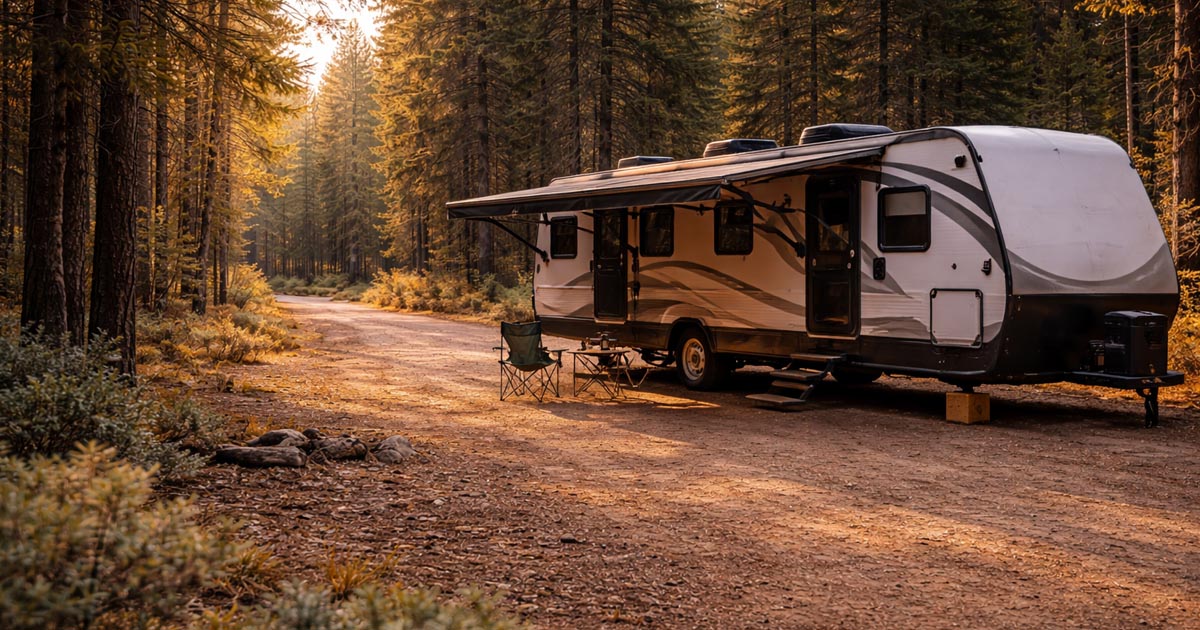
The U.S. Forest Service manages 193 million acres across 154 national forests, and most of that land allows free camping. No reservation, no fee, no campground host. You drive in, find a spot, and camp. But free camping in national forests doesn’t mean “no rules.” The rules are straightforward — simpler than campground reservations, in fact — but they’re different from BLM land, different from state parks, and different depending on which forest you’re in. If you’re bringing an RV, the rules narrow further. National forest dispersed camping has vehicle restrictions that generic camping guides never mention.
This guide covers the framework: what’s allowed, what’s restricted, how to read the Motor Vehicle Use Map, the RV-specific realities most guides skip, and which forests across the country are worth your time. If you’re new to camping on public land entirely, start with our complete dispersed camping guide for the full picture across all land types. If you’re coming from the RV or van life world and searching for “boondocking,” see our boondocking for beginners guide — it’s the same activity, different vocabulary.
What “Free Camping” Actually Means in National Forests
This distinction matters because it trips up more people than any rule does: free camping in national forests means dispersed camping. It means camping outside developed campgrounds — no picnic table, no fire grate, no vault toilet, no designated pad, no fee. You find an existing pull-off or cleared area along a forest road, set up camp, and manage everything yourself.
It does not mean free developed campgrounds. Developed campgrounds in national forests — the ones with numbered sites, picnic tables, fire rings, and vault toilets — almost always charge a fee, typically $5–$25 per night. A handful of remote developed sites are fee-free, but they’re rare exceptions, not the rule. When people search “free camping in national forests,” they’re almost always looking for dispersed camping, whether they know the term or not.
USFS dispersed camping is allowed on most National Forest land unless posted otherwise. But “most” isn’t “all.” Some forests restrict dispersed camping to designated corridors along specific roads. Some require a free self-registration permit. Some prohibit it in certain zones — near developed recreation areas, along popular trails, in sensitive watersheds. The default is “allowed,” but the exceptions are common enough that checking the specific forest’s rules before your trip is not optional.
National Forest Camping Rules — The Framework
The core rules apply across all 154 national forests. Individual forests add their own restrictions on top of these, but this is the baseline.
The 14-Day Stay Limit
You can camp in one location for 14 consecutive days. After that, you must move — the standard is at least 25 miles, though some forests say 5 miles, some say “a different ranger district,” and some don’t specify a distance at all. The 14-day stay limit on national forest land is federal regulation, not a suggestion. After you move, the clock resets and you can stay another 14 days in the new location. This isn’t designed to prevent long-term use of national forests — it’s designed to prevent one person from occupying a site for the entire season and turning dispersed camping into a permanent residence.
Where You Can and Can’t Camp
The Motor Vehicle Use Map is the governing document. If a road isn’t shown on the MVUM, you can’t drive it — and if you can’t drive there legally, you can’t camp there with a vehicle.
Within the MVUM’s road network, the general rules are:
- Camp on previously disturbed ground — look for existing fire rings, cleared pull-offs, and established sites where others have clearly camped before. Never drive off-road to create a new site.
- Stay 100–200 feet from water sources — streams, lakes, springs. The exact distance varies by forest. When in doubt, go farther.
- Camp away from trailheads, developed campgrounds, and picnic areas — typically at least 1 mile, though this varies.
- Not in posted restricted areas, active logging zones, or gated roads.
The pattern is simple: use existing sites, stay away from water and developed areas, and follow the roads shown on the MVUM.
Fire Rules
Fire restrictions in national forests vary by forest, by season, by year, and sometimes by elevation within the same forest. There is no blanket “fires are allowed in national forests” or “fires are banned.” You check before every trip — not once per season.
When fires are allowed: use existing fire rings only. Never build a new fire ring. Never cut standing trees for firewood — use dead and down wood only. Keep the fire small. Extinguish completely before leaving — stir, douse, stir, feel.
When fire restrictions are in effect: no campfires, period. Camp stoves with shutoff valves are typically still allowed under most restriction levels. Check the specific restriction stage — Stage 1 and Stage 2 prohibit different things.
California national forests require a free campfire permit year-round, even when no restrictions are in effect. You can get one online in five minutes. Other forests have similar requirements — check before you go.
Permits
This is where the confusion lives. Most national forests do not require a permit for dispersed camping. You don’t need to register, check in, or carry a pass.
The exceptions:
- Some forests — especially in the East, Southwest, and California — require a free self-registration permit. This is usually a card you fill out at a trailhead kiosk or download from the forest’s website.
- California requires a campfire permit for any open flame, including camp stoves, in all national forests. Year-round. Free, available online.
- The Northwest Forest Pass and the America the Beautiful Interagency Pass are for developed trailheads and day-use areas. They are not required for dispersed camping. This is the most common permit misconception — people think they need a pass to camp in a national forest. You don’t. The pass is for parking at developed trailheads, not for sleeping on forest land.
When in doubt: check the specific forest’s website under “dispersed camping” or “camping outside developed campgrounds,” or call the ranger district. A two-minute phone call resolves every permit question.
RV Rules — What Changes With a Bigger Vehicle
Everything above applies to all vehicles. But free camping with an RV introduces restrictions that car campers never encounter. If you’re bringing an RV — Class A, Class C, fifth wheel, travel trailer, truck camper — the national forest dispersed camping experience comes with restrictions that car campers never think about.
Road Classifications and Vehicle Limits
The Motor Vehicle Use Map doesn’t just show which roads exist. It classifies roads by vehicle type. Some roads are open to all motorized vehicles. Some restrict vehicle width. Some restrict vehicle length. Some are designated “highway legal vehicles only,” which can exclude certain trailer configurations on specific roads.
The MVUM legend shows these classifications with symbols. Learning to read them takes ten minutes and saves you from driving a 30-foot trailer down a road that was designed for a pickup truck. The key thing to look for: the vehicle class restriction symbol next to each road segment. If your vehicle doesn’t fit the classification, that road isn’t legal for you — and more importantly, it probably isn’t physically possible for you.
In practice, national forest RV camping works best on main forest roads — the numbered routes that connect to state highways. The further you go down spur roads and unnamed forest tracks, the narrower, rougher, and less turnaround-friendly things get.
Physical Realities of Forest Roads
Forest roads are not highways. They’re single lane, no shoulder, blind curves, steep grades, low-hanging branches, exposed rocks, and seasonal ruts. A road that’s perfectly fine for a Tacoma can be impassable for a Class A motorhome — not because it’s illegal, but because the turning radius doesn’t work, the branches scrape your roof, or there’s no turnaround at the end.
Free camping with an RV on national forest land requires one skill that car campers don’t need: the ability to assess whether you can physically navigate a road before you commit. If you can’t turn around, you’re backing out. On a narrow mountain road. Potentially for miles. With no shoulder and a drop-off.
The safe approach: scout the road first without the trailer if possible. Drive in with your tow vehicle, check the road conditions and turnaround situation, and then come back with the rig. Or — and this is genuinely the best option — call the ranger district. They know which roads accommodate which vehicle sizes because they answer this question every day.
Site Considerations for RVs
Dispersed camping sites aren’t built. They’re whatever flat-ish ground exists at the pull-off. For an RV, that means:
- Leveling: Bring leveling blocks. You won’t find a level pad. A couple inches of slope that you wouldn’t notice in a tent makes an RV unlivable.
- Generator hours: Daytime only is the unwritten rule across all national forests. Some forests have posted generator hours (typically 6 AM–10 PM). Running a generator at midnight is a fast way to become the person everyone in the area resents.
- No hookups: You’re on your own for power, water, and waste. Your freshwater tank, grey tank, and black tank capacity determine how long you can stay — not the 14-day limit.
- Grey water: Some forests allow ground scatter at least 200 feet from water sources. Some don’t — check the specific forest. Black water always requires a dump station. No exceptions. Never dump at the site.
- Slide-outs: Check clearance. Trees, rocks, and uneven ground don’t respect your slide-out dimensions.
How to Read the Motor Vehicle Use Map
The MVUM is the single most important document for dispersed camping road access in national forests, and most camping guides give it one sentence. Here’s what you need to know.
Every national forest publishes a Motor Vehicle Use Map — a free, downloadable PDF that shows every road and trail legally open to motorized use. It’s updated periodically (usually annually) and is the legal authority on where you can and can’t drive.
What the MVUM shows:
- Roads open to all motor vehicles (solid lines)
- Roads with seasonal or vehicle-type restrictions (dashed lines or annotated symbols)
- Vehicle class designations (symbols showing which vehicle types are allowed on each road segment)
- Designated dispersed camping corridors — some forests mark specific road segments where corridor camping is permitted
- Trail designations for ATVs, motorcycles, and other OHV use
What it doesn’t show:
- Current road conditions (a road can be legally open and physically impassable)
- Seasonal gate closures (the map shows the road’s legal status, not whether the gate is up)
- Campsite quality, availability, or suitability for your vehicle
- Private land inholdings within the forest boundary
Where to get it: Search “[forest name] Motor Vehicle Use Map” on the USFS website. Most are available as downloadable PDFs. Some forests have interactive online map viewers. Print the relevant sections — cell signal is unreliable on forest roads.
Cross-reference the MVUM with apps: Gaia GPS for public land ownership layers, FreeRoam for public land boundaries, iOverlander for user-reported dispersed sites with recent reviews. The MVUM tells you where you can legally drive. The apps tell you where people have actually camped. You want both. For the full step-by-step workflow, see how to find dispersed camping sites.
Best National Forests for Free Camping
Not all national forests are created equal for dispersed camping. Picking the best national forests for camping depends on your region, your vehicle, and your season. Some have extensive road networks with dozens of established dispersed sites. Others are more restrictive, harder to access, or so popular that finding an open site requires a Tuesday arrival. These are forests we’d actually recommend — organized by region, with enough detail to start planning.
Western Forests
Coconino National Forest (Arizona). One of the most popular dispersed camping forests in the country, and for good reason. Year-round access at lower elevations around Sedona and Flagstaff, massive dispersed camping areas, and a well-maintained forest road network. The corridors along FR 525 and FR 700 are RV-accessible and heavily used. Coconino gets crowded on weekends — arrive by Thursday for peak-season trips. Some areas require a Red Rock Pass (developed trailheads only, not dispersed camping — but the signage is confusing). Best season: spring and fall at lower elevations, summer at higher elevations.
Fishlake National Forest (Utah). Less crowded than Utah’s more famous forests (Dixie, Manti-La Sal) and excellent for dispersed camping. High-elevation summer camping with aspen groves, open meadows, and long views. Forest roads are generally well-maintained. Good RV access on primary routes — spur roads narrow quickly. Fall color season (late September through mid-October) is spectacular and relatively uncrowded compared to Colorado. Best season: June through October.
Rio Grande National Forest (Colorado). Southern Colorado, far enough from Denver and the Front Range that the weekend traffic is manageable. Mix of high-alpine terrain and wide valley floors with excellent dispersed corridors along the main forest roads. RV-friendly on lower-elevation routes — the high passes require shorter, more maneuverable vehicles. Less crowded than White River, Pike, or San Isabel. Best season: June through September.
Pacific Northwest
Deschutes National Forest (Oregon). The dispersed camping culture here is deeply established. Cascades terrain, volcanic geology, excellent road network, and hundreds of established dispersed sites along highway corridors south and west of Bend. Some areas get heavy use in summer — the Cascade Lakes Highway corridor fills fast on weekends. Good RV access on main routes. Some areas near trailheads require a Northwest Forest Pass for day parking (not for dispersed camping — this confusion costs people unnecessary money). Best season: June through October.
Okanogan-Wenatchee National Forest (Washington). The eastern side of the Cascades — drier, sunnier, and more accessible than the rain-soaked western-slope forests. Good dispersed camping along river corridors with established sites that see moderate use. Seasonal access is the main limitation — many roads close November through May due to snow. RV access varies by corridor — the main forest roads work, the spur roads don’t. Best season: June through September.
Eastern and Southern Forests
Cherokee National Forest (Tennessee). One of the best eastern national forests for dispersed camping. Appalachian terrain with a good road network and a more relaxed approach to dispersed camping than many eastern forests. Fewer established dispersed sites than western forests — you’ll need to scout more carefully and may need to camp in spots that are less obviously “sites.” The upside: far less competition. Best season: April through November.
Ocala National Forest (Florida). A completely different dispersed camping experience — flat, sandy, subtropical, year-round access. Dispersed camping is allowed in some areas with a free permit. Popular with winter snowbirds escaping northern cold. Expect humidity, bugs (especially mosquitoes from May through October), and dense undergrowth. RV access is good on main forest roads. If you’ve only dispersed camped in the West, Ocala will feel like a different activity. Best season: November through March.
What to Bring
This article isn’t a gear guide — the gear lists exist elsewhere on the site. But the basics for national forest dispersed camping:
Water. One gallon per person per day minimum. There’s no water at dispersed sites. Fill up at the last town before you leave pavement. For the full breakdown on containers, filtration, and how much you actually use, see our dispersed camping water guide.
Waste management. WAG bags or a trowel for cat holes (6–8 inches deep, 200 feet from water). Ziplock bags for toilet paper — pack it out, do not bury it. Heavy-duty trash bags for all other garbage.
Fire safety. Shovel and water at the fire ring — if fires are allowed. Check restrictions before every trip.
Paper MVUM. Your phone will lose signal. The MVUM doesn’t need a battery.
Satellite communicator. Garmin inReach, Zoleo, or SPOT. Not negotiable for remote forest roads where cell service doesn’t exist.
For RVs: Leveling blocks, extra fuel (rural gas stations near forests sometimes close seasonally), traction boards for soft or muddy ground, and patience for forest road driving.
Leave No Trace on National Forest Land
The same leave no trace principles that apply to all dispersed camping apply here — and they matter more in national forests because of how visible the damage is.
Use existing sites and existing fire rings. Never create new ones. Pack out all trash, food scraps, and toilet paper. Dig cat holes 6–8 inches deep, 200 feet from water, trails, and camp. Scatter grey water at least 200 feet from water sources — strained through mesh first.
The reality: national forests are closing dispersed camping areas. Coconino restricted several popular corridors. Deschutes added new regulations around high-use areas. The closures follow a pattern — trash, fire scars, human waste, and social trail proliferation. Every clean site you leave is an argument for keeping these areas open. For the full breakdown of what matters most and what to prioritize, see our dispersed camping leave no trace guide.
The Bottom Line
Free camping in national forests is one of the best deals in outdoor recreation — 193 million acres across the country, no reservations, no fees. The national forest camping rules are simple: 14-day limit, camp on disturbed ground, stay away from water, follow the MVUM, pack everything out. If you’re in an RV, the MVUM is your most important document and the ranger district phone number is your most important contact. Start with the closest national forest to where you live, download the MVUM, and go for one night. The system works. It just requires knowing the rules before you leave the driveway.
Frequently Asked Questions
Can you camp for free in national forests?
Yes. Most of the 154 national forests in the United States allow free dispersed camping — camping outside developed campgrounds without fees, reservations, or hookups. You camp on previously disturbed ground, follow the Motor Vehicle Use Map for road access, and observe the 14-day stay limit. Some forests restrict dispersed camping to designated corridors or require a free permit.
What are the rules for dispersed camping in national forests?
The core rules: 14-day stay limit, camp on previously disturbed ground, stay 100–200 feet from water sources, use existing fire rings only (when fires are allowed), and follow the Motor Vehicle Use Map for legal road access. Pack out all trash, waste, and toilet paper. Some forests have additional restrictions — check the specific forest’s website or call the ranger district.
Can you camp in a national forest with an RV?
Yes, but with restrictions. Forest roads are classified by vehicle type on the Motor Vehicle Use Map — some roads restrict vehicle width or length. Many spur roads and dispersed camping corridors have no turnaround for vehicles over 25 feet. Scout roads first or call the ranger district for conditions. There are no hookups — your tank capacity is your stay limit.
How long can you stay in a national forest?
The standard limit is 14 consecutive days in one location. After 14 days, you must move — typically at least 25 miles, though the exact distance varies by forest. The clock resets after the move. This applies to dispersed camping and most developed campgrounds on National Forest land.
Do you need a permit to camp in a national forest?
Most national forests do not require a dispersed camping permit. Some forests — particularly in the East, Southwest, and California — require a free self-registration permit or campfire permit. The Northwest Forest Pass and America the Beautiful Pass are for developed trailheads and day-use areas, not for dispersed camping. Check the specific forest’s website before your trip.
What is the best national forest for free camping?
It depends on your region and season. In the West, Coconino (Arizona), Fishlake (Utah), and Rio Grande (Colorado) offer excellent dispersed camping with good road networks. In the Pacific Northwest, Deschutes (Oregon) has a strong dispersed camping culture. In the East, Cherokee (Tennessee) is one of the most accessible. Start with the closest national forest to you and work outward.