Dispersed Camping with Dogs: Rules, Gear, and What We Learned
Dispersed camping with dogs — leash rules by land type, gear that changes, wildlife safety, waste management without a trash can, and where dogs are welcome.
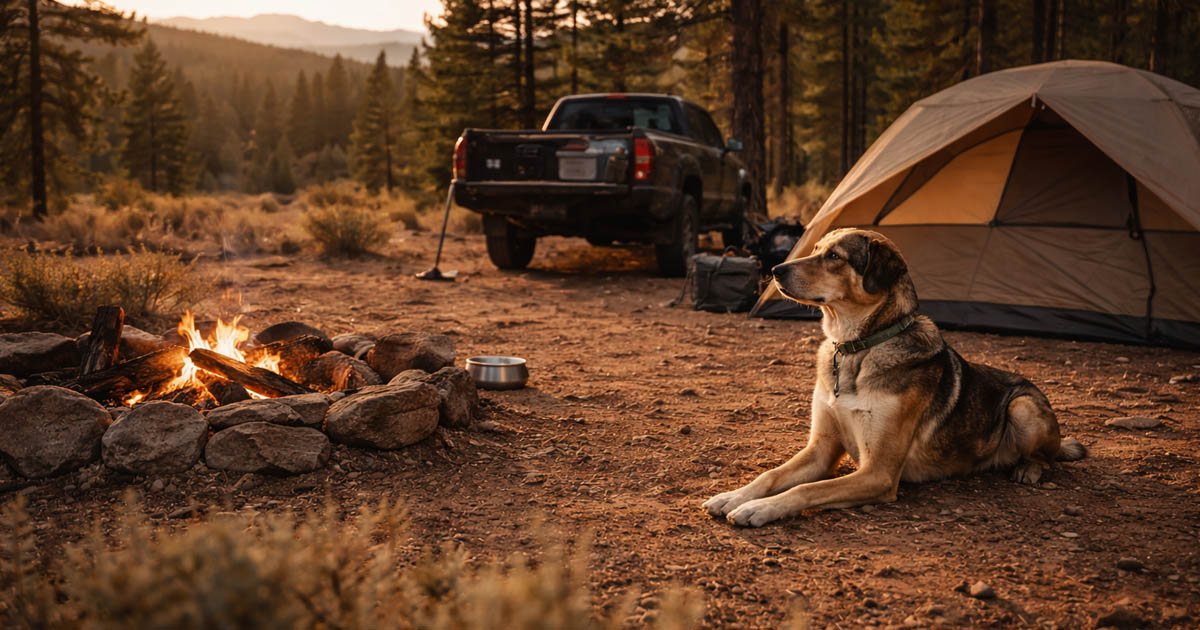
Our dog has been on every dispersed camping trip we’ve taken in the last four years. She’s slept in the truck bed in Colorado at 9,000 feet, sprawled under a juniper in Utah at 95 degrees, and once ate something unidentifiable off a BLM road in Nevada that kept us both up until midnight. She’s a better camping partner than most humans — no complaints about the road, no opinions about the campsite, genuinely thrilled by every new smell.
But dispersed camping with dogs is different from pulling into a KOA with a pet. There’s no camp host to call if your dog tangles with a porcupine at 2 AM. No vet down the road. No trash can for three days of waste bags. No fence between your site and the coyotes yipping in the wash. Most “camping with dogs” guides are written for campgrounds with amenities and ranger stations. This one is written for dog-friendly dispersed camping on BLM pulloffs and forest roads where you’re on your own. If you’re new to dispersed camping in general, start with our complete dispersed camping guide for the fundamentals. This article covers what changes when you bring a dog.
Dog Rules on Public Land — What’s Actually Required
The rules depend entirely on who manages the land. This is where most camping with dogs guides get it wrong — they give blanket advice that doesn’t match the reality of different land managers.
BLM Land
BLM has no blanket leash requirement on undeveloped land. On most open BLM acreage — the kind where you’re pulling off a dirt road onto a flat clearing — your dog can be off-leash. That’s one of the reasons camping with dogs on BLM land is popular with dog owners who want their animals to have room to roam.
The caveats matter. Some BLM Special Recreation Management Areas, designated camping corridors (like those near Moab), and areas adjacent to national parks do have leash requirements. The rules are set by the local BLM field office, not a national policy. And regardless of leash status, you’re responsible for your dog at all times. A dog chasing wildlife on BLM land is a federal violation — wildlife harassment carries fines, and your dog chasing a deer across the desert isn’t “playing.”
Check the local BLM field office website for your specific area before assuming off-leash is fine.
National Forest (USFS) Land
Dogs on national forest land follow forest-specific rules, not a national standard. Most forests require leashes in developed recreation areas — campgrounds, trailheads, picnic areas, swimming beaches. For dispersed camping along forest roads, the rules vary:
- Some forests (like the Pike and San Isabel in Colorado) require leashes on all trails and in all camping areas.
- Others allow off-leash with “voice and sight control” in dispersed areas.
- Wilderness areas within national forests generally allow dogs but may require leashes — check the specific wilderness order.
The forest order for your specific national forest is the authority. Not a blog. Not an app review. The actual forest order, available on the USFS website or by calling the ranger district. We’ve seen conflicting information on every app we use — the forest order settles it.
Where Dogs Can’t Go
Some public land is off-limits to dogs entirely:
- National parks: Dogs are prohibited on nearly all trails and in all backcountry areas. A handful of paved paths, roads, and campgrounds allow leashed dogs, but if you’re planning dispersed-style camping near a national park, your dog is staying at camp while you hike.
- Some wildlife management areas: Seasonal closures for elk calving, sage grouse nesting, or raptor nesting may prohibit dogs during critical periods. These are often posted but not always well-marked.
- Specific trail closures: Some popular trails within national forests close to dogs seasonally for wildlife reasons.
Dog Gear That Changes for Dispersed Camping
You already have a leash, bowls, and food. Here’s the dog camping gear that changes when there’s no campground infrastructure.
Tie-Out and Containment
At a dispersed site, there’s no fence, no pet area, and no camp host to watch your dog while you’re dealing with the fire or cooking. You need a reliable containment system.
We use a 30-foot coated steel cable tie-out with a corkscrew ground stake. It holds in packed dirt, gravel, and most forest ground. It gives the dog enough room to be comfortable — shade, water bowl, a spot to lie down — without reaching the fire ring, the food prep area, or the road. We tried a portable x-pen early on and it worked in calm conditions, but our dog leaned against it in wind and it collapsed. The cable hasn’t failed.
Alternatives: a long lead clipped to a vehicle axle works as a backup. A portable dog pen works if your dog isn’t a leaner or digger. Whatever you use, test it at home before you rely on it 40 miles from pavement.
One note: never tie a dog to a tent or tent stake. A spooked dog will drag a tent into the desert. We’ve seen it happen.
Water — Your Dog Drinks More Than You Think
This one catches people, especially in desert conditions. A 50-pound dog can drink a gallon of water per day in summer heat. That’s on top of your own water planning. For a three-day trip with one dog, add 3 gallons to your water load — about 25 extra pounds.
We carry a dedicated 2.5-gallon jug for the dog plus a collapsible bowl at camp. The dog jug gets refilled at every town stop alongside our own containers. If you’re heading to desert BLM land, the water planning matters more — see the desert water math in our guide to dispersed camping in Utah.
Paw Protection
Forest roads have sharp rocks. Desert BLM has hot sand, thorns, cactus spines, and goathead stickers. Our dog has tough pads from years of hiking, and we’ve still pulled thorns from her paws at 10 PM on a dirt road south of Hanksville. Not a great experience for either of us.
Options: dog booties (Ruffwear Grip Trex are the standard — they stay on), paw wax (Musher’s Secret) for prevention, or just awareness and a pair of tweezers. If your dog isn’t used to rough terrain, start with short outings and check paws frequently.
Hot ground rule: if you can’t hold the back of your hand on the ground for 5 seconds, it’s too hot for your dog’s paws. In Utah in June, that means staying off exposed rock and sand between 10 AM and 4 PM.
Dog First Aid Kit
The vet might be 60 miles away down a dirt road. A basic dog first aid kit fills the gap:
- Styptic powder — stops bleeding from torn nails (happens on rocky terrain)
- Tweezers and hemostats — for thorns, cactus spines, porcupine quills
- Benadryl — for allergic reactions, bee stings, snake bites (temporary measure). Dose: 1 mg per pound of body weight
- Hydrogen peroxide (3%) — to induce vomiting if the dog eats something toxic. Dose: 1 teaspoon per 10 pounds. Call poison control or a vet first if you have signal.
- Gauze, vet wrap, and wound wash — for cuts and lacerations
- Tick removal tool — spring and summer in any forested area
- Dog-specific sunscreen — for pink-nosed or light-skinned dogs in the desert
Know the location of the nearest emergency vet before every trip. We keep a note in our phone with the closest vet clinic to each area we camp in.
Wildlife, Hazards, and Keeping Your Dog Safe
This section is why dispersed camping with dogs requires more awareness than a campground stay. Dog safety camping on public land means understanding the specific threats.
Wildlife Encounters
Porcupines — The most common and most painful encounter. Porcupines are nocturnal, so the risk spikes after dark. A dog’s instinct is to investigate with its mouth — the result is dozens or hundreds of quills embedded in the face, mouth, and paws. We’ve seen it twice at dispersed sites. Both dogs needed a vet.
Prevention: keep the dog on the tie-out or inside after dark. If your dog is a nighttime roamer, this alone justifies a containment system. If quilling happens and it’s minor (a few quills in the muzzle), you can remove them with pliers — grip close to the skin and pull straight out at the angle they entered. For heavy quilling (dozens of quills, quills in the mouth or eyes), drive to an emergency vet. Don’t cut quills before removing — it doesn’t help and makes them harder to grip.
Coyotes — Generally not a threat to large dogs (over 40 pounds), but a real danger to small dogs. Coyotes are most active at dawn and dusk. They’ve been documented luring dogs away from camp — a single coyote plays and retreats, drawing the dog further from camp, where the pack is waiting. Keep small dogs inside or on a short tie-out at night. For large dogs, the risk is lower but a coyote encounter can still mean a fight, injuries, and a long drive to a vet.
Bears — A dog that chases a bear can bring it back to camp. This is well-documented and is the strongest argument for keeping dogs contained in bear country. The scenario: your off-leash dog spots a bear, gives chase, the bear turns, the dog runs back to you — with the bear following. If you’re dispersed camping in bear country (most of Colorado, parts of Utah, the Sierra), a tie-out isn’t optional. It’s safety equipment.
Other Hazards
Foxtails and grass awns — These barbed seed heads embed in ears, between toes, in nostrils, and under eyelids. They only travel forward once embedded and can cause serious infections. Check your dog thoroughly after any outing in dry grass — run your fingers between every toe, check inside ears, and look in the mouth. Common in California, the Great Basin, and the Southwest.
Toxic algae (cyanobacteria) — Blue-green algae in still, warm water can kill a dog within hours of ingestion. If pond or lake water looks green, has a paint-like film, or smells musty — keep the dog out completely. Not partially. Completely. This isn’t overstated. It’s that fast.
Heat — Dogs can’t sweat. They cool themselves by panting, which is inefficient in dry desert air. A dispersed site on open BLM land with no shade in July is dangerous for a dog. Signs of heat stress: excessive panting, drooling, lethargy, stumbling. Treatment: wet the dog down (belly and paws especially), get to shade, offer water. If you’re desert camping, bring a shade structure or camp under the vehicle awning. If it’s over 100°F, consider whether the dog should be on this trip.
Dog Waste at a Dispersed Site — The Awkward Reality
Nobody writes about this, but everyone who camps with a dog deals with it. At a campground, you bag the waste and drop it in a trash can. At a dispersed site, there is no trash can. Here’s how to manage dog waste camping for multiple days.
Bag and pack out: This is the Leave No Trace standard. Double-bag in biodegradable waste bags, and store them in a dedicated sealed container. We use a small dry bag clipped to the outside of the truck tailgate. It contains the smell, it’s off the ground, and it goes into the first trash can we pass on the way out. Not glamorous. It works.
Bury it: Acceptable on BLM and USFS land under the same rules as human waste. Dig a cat hole 6–8 inches deep, at least 200 feet from water sources, trails, and camp. Some land managers actually prefer this to bags — too many people bag waste and then leave the bag at the site or hanging from a tree, which is worse than not bagging at all.
What not to do: Don’t leave bagged waste at the site. Don’t hang bags from trees (this is shockingly common). Don’t toss bags into the brush. Don’t assume “it’s biodegradable” excuses anything — a plastic bag of dog waste in the desert will be there for years. We’ve picked up other people’s dog waste bags at dispersed sites more times than we’d like. It’s the number one reason land managers consider restricting dogs from popular areas.
Etiquette — Your Dog, Other Campers, and the Unwritten Rules
The biggest complaints about dogs at dispersed sites come down to three things: off-leash dogs in other people’s camps, barking, and waste. These camping with dogs tips apply specifically to dispersed sites where there’s no camp host to mediate.
Off-leash etiquette: Off-leash camping with dogs works when your dog has genuine voice recall — not “usually comes when called” but “always comes when called, even when there’s a rabbit.” The moment another camper is visible, leash up. The person who drove 40 miles down a dirt road came for solitude, not a surprise visit from your dog. We keep our dog off-leash at camp when we’re alone and have clear sight lines. The second we see another vehicle, she goes on the tie-out. No exceptions.
Barking: Sound carries at dispersed sites. No walls, no background noise, no traffic to drown it out. A dog barking at every critter, every gust of wind, every distant engine is going to be heard for a quarter mile in every direction. If your dog is a barker, you’re not a bad owner — but you need a plan. Exercise them hard before settling in for the evening. Bring them into the vehicle at night if that calms them. Some dogs bark less when they can see you — position the tie-out where you’re in their sight line.
Other dogs at camp: Not every dog you encounter at a dispersed site is friendly. Forest roads see hunting dogs, working ranch dogs, and reactive dogs alongside family pets. Keep first encounters leashed and controlled. Let dogs sniff at a distance before deciding whether closer interaction is safe. We’ve had friendly meetings and tense standoffs — assume nothing.
Wildlife harassment: A dog chasing deer, elk, birds, or any wildlife on public land is a federal violation. It’s also how dogs get lost — a dog chasing a deer through unfamiliar terrain can end up miles from camp with no way to find you. Keep them contained.
Where to Take Your Dog Dispersed Camping
For finding dog-friendly dispersed camping sites, the process is the same as finding any dispersed site — with one extra step: check the dog rules for your specific area. Our full process is in how to find dispersed camping sites.
The short version for best places to camp with dogs on public land:
- BLM land is generally the most permissive. Open terrain, off-leash often allowed, fewer restrictions. The desert Southwest — Utah, Arizona, Nevada, eastern Oregon — has vast BLM areas where dogs run free. See our guide to dispersed camping in Utah for specific BLM areas.
- National forests are excellent for dogs but check the specific forest order for leash rules. Colorado’s national forests have some of the best dispersed camping in the country — see our guide to dispersed camping in Colorado for forest-by-forest details.
- Avoid planning trips that center on national park trails if your dog is coming — they can’t join you on the trail, and leaving a dog in a hot vehicle at a trailhead is dangerous and often illegal.
When checking iOverlander or Campendium for sites, search reviews for “dog” mentions — other dog owners often note whether an area worked well for dogs, whether there were wildlife concerns, and whether they saw leash enforcement.
The Bottom Line
Your dog doesn’t need a developed campground. They need water, shade, a reliable containment system, and you paying attention to the terrain and wildlife around you. Dispersed camping with dogs takes more preparation than camping solo — more water, more gear, more situational awareness — but the trade-off is a camp partner who’s genuinely thrilled to be there, every single time.
Start simple: pick a national forest within a couple hours of home, confirm the dog rules with the ranger district, pack extra water and a tie-out, and go for one night. Your dog will thank you in a way only a dog can — by lying in the dirt next to the fire, chewing a stick, and looking at you like this is the greatest day of their entire life.
Frequently Asked Questions
Can you take dogs dispersed camping?
Yes, dogs are allowed at most dispersed camping sites on BLM and National Forest land. BLM land generally has no leash requirement on undeveloped areas. National forests vary by specific forest order — some require leashes in all areas, others allow off-leash with voice control. Dogs are not allowed on most national park trails or backcountry areas.
Do dogs have to be on a leash on BLM land?
Not on most open, undeveloped BLM land. BLM has no blanket leash requirement for dispersed camping areas. However, some BLM recreation areas and designated camping corridors near national parks do require leashes. You’re always responsible for preventing wildlife harassment — that’s a federal violation regardless of leash status. Check with the local BLM field office for your specific area.
Are dogs allowed on national forest land?
Yes, on most national forest land. Leash rules vary by forest — developed recreation areas typically require leashes. For dispersed camping on forest roads, check the specific forest order. Some forests require leashes everywhere; others allow off-leash with voice control. Wilderness areas generally allow dogs but some require leashes.
How do you camp with a dog in the backcountry?
Bring extra water (a 50-pound dog can drink a gallon per day in heat), a reliable tie-out or containment system, a dog-specific first aid kit, and paw protection for rough terrain. Plan for waste management without a trash can — bag and pack out, or bury under the same rules as human waste. Keep the dog contained after dark to avoid porcupine and wildlife encounters.
What do you do with dog poop when dispersed camping?
Two options: bag it and pack it out in a sealed container (the Leave No Trace standard), or bury it 6–8 inches deep at least 200 feet from water, trails, and camp — the same rules as human waste on public land. Never leave bagged waste at the site or hanging from trees. We use a small dry bag clipped to the vehicle to contain smell during multi-day trips.
Is dispersed camping safe for dogs?
It’s safe with preparation. The main risks are wildlife encounters (porcupines after dark, rattlesnakes in warm months, coyotes for small dogs), heat exposure at desert sites, sharp terrain on paws, and toxic algae in still water. Bring a dog first aid kit, keep the dog contained at night, know the nearest emergency vet before the trip, and carry extra water. Rattlesnake aversion training is recommended for dogs in the western US.