Dispersed Camping in Winter: What Changes and What Doesn't
Dispersed camping in winter — what changes about access, water, sleep, and safety, and when to stay closer to plowed roads.
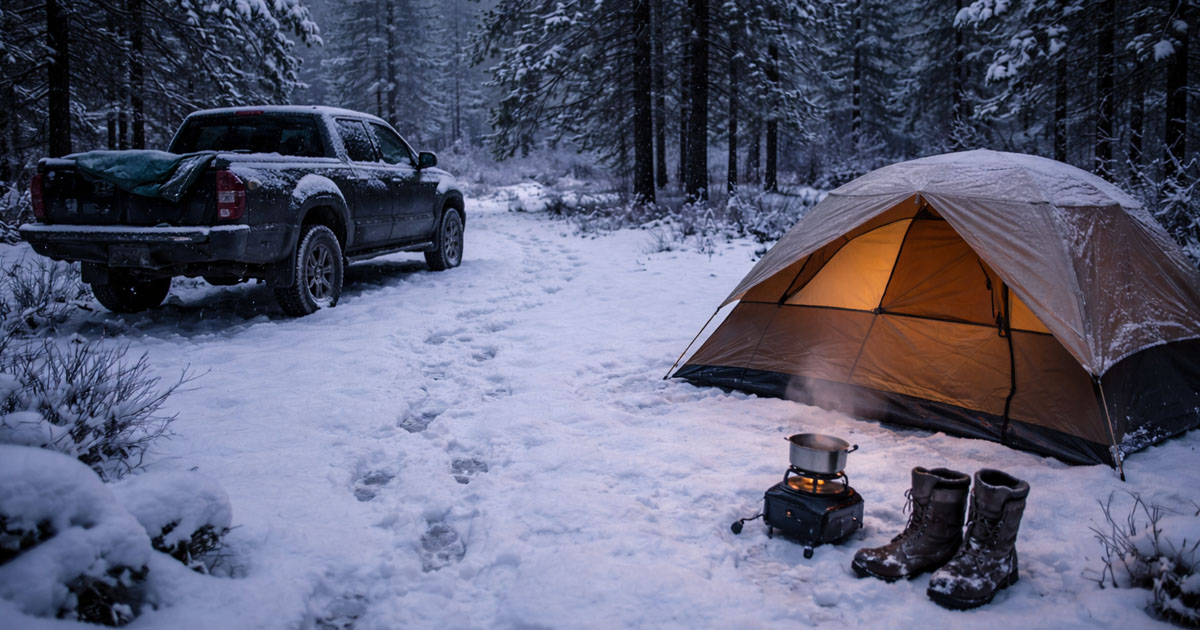
Dispersed camping in winter doesn’t require a different skill set — it requires a different margin of error. If you’ve dispersed camped in summer, you already know the rules, the process for finding sites, and the baseline gear. Winter doesn’t rewrite any of that. But it changes five things in ways that matter, and getting any of them wrong carries higher consequences than a sweaty night in August. Most winter camping tips you’ll find online are written for developed campgrounds with plowed roads and heated restrooms. This is about the dispersed sites — the forest roads, the BLM land, the spots where the nearest help is 30 miles of unplowed road away.
We’ve dispersed camped through three winters now — desert BLM trips in Utah where January days hit 55°F and mountain sites in Colorado where we woke up to 12°F and ice on the inside of the windshield. This guide covers what genuinely changes, what stays exactly the same, and how to decide whether a winter dispersed trip is a reasonable stretch or a bad idea. If you haven’t dispersed camped at all yet, start with our complete dispersed camping guide — get a few warm-weather trips under your belt first.
What Stays the Same
The rules don’t change with the season. The 14-day stay limit on BLM and National Forest land applies year-round. You still camp on previously disturbed ground, stay 200+ feet from water, and follow the Motor Vehicle Use Map. LNT principles are identical — and in some ways easier in winter, because frozen ground is more durable than summer mud. The process for finding dispersed camping sites is the same: MVUM, apps, land ownership verification, backup sites.
Your core gear list is also the same foundation. Shelter, cooking system, sanitation supplies, fire safety tools, satellite communicator — all of it carries forward. Winter doesn’t replace your summer setup. It adds to it.
What Changes — Access and Road Conditions
This is the single biggest difference between summer and winter dispersed camping. In July, the forest road is open and dry. In January, it might be gated, snow-covered, mud-trapped, or technically open but physically impassable. Dispersed camping road conditions are the first thing to check and the most common reason a winter trip gets rerouted.
Seasonal Road Closures
Many national forest roads close seasonally — gates go up as early as November and don’t reopen until May or June, depending on elevation and snowpack. The MVUM shows which roads exist, but it doesn’t always reflect seasonal closures. You need two sources: the MVUM for legal road status and the forest’s travel management page (or a phone call to the ranger district) for current conditions.
BLM roads are less likely to be gated but can still be impassable. Mud in shoulder seasons (November, March–April) can trap a vehicle faster than camping in snow does. Lower-elevation BLM land in southern Utah, Arizona, and New Mexico is the sweet spot for winter dispersed camping — often dry and accessible when mountain roads are buried under feet of snow.
Reading Road Conditions Before You Go
Don’t drive two hours to find a closed gate. Check before you leave:
- Forest road status pages: Each national forest maintains one. Search “[forest name] road conditions” or “[forest name] travel management.”
- Call the ranger district: The most current, most reliable source. A two-minute call saves a wasted trip.
- Recent trip reports: iOverlander reviews dated within the last month, overlanding forums, Reddit. Look for “January” or “February” reports specifically.
- “Open” vs. “passable”: A road can be legally open on the MVUM and buried in 2 feet of snow. “Open” is a legal status. “Passable” is a physical one. You need both.
Vehicle Preparation
Winter forest roads demand more from your vehicle. 4WD or AWD with decent all-terrain tires is the baseline — 2WD on a snowy or muddy forest road is asking to get stuck. Carry tire chains and know how to put them on before you need them (practice in the driveway, not at 9 PM in the snow). Recovery gear matters more in winter: traction boards, a tow strap, and a shovel are no longer optional. Keep the fuel tank above half — cold weather increases fuel consumption, and rural gas stations near dispersed areas sometimes close seasonally.
What Changes — Water and Freezing
Your warm-weather water system fails in winter. The Aqua-Tainers, collapsible jugs, and gravity filter that work perfectly in July are a problem in January. For the full water system breakdown, see our dispersed camping water guide — everything below is the winter adaptation.
What Freezes and When
Rigid containers like Aqua-Tainers start freezing overnight at roughly 25°F ambient. By 15°F, expect a solid block by morning — 7 gallons of ice weighing 58 pounds that’s useless until it thaws. Collapsible jugs freeze faster because of their thinner walls and higher surface-area-to-volume ratio.
Water filters are the hidden risk. Pump filters and gravity filters (Sawyer Squeeze, Platypus GravityWorks, MSR MiniWorks) have internal water channels that freeze and expand, cracking the filter element. A frozen filter looks fine but may no longer remove bacteria. If you’re bringing a filter in winter, sleep with it in your sleeping bag. Not next to the bag. In it.
Keeping Water Liquid
Store water containers in the vehicle overnight with windows closed — the vehicle interior stays warmer than ambient air, especially if you’re sleeping in it. Wrap containers in sleeping pads or blankets for extra insulation. For trips below 20°F, switch from 7-gallon containers to 1-gallon jugs — a frozen gallon thaws in a few hours on the dashboard. A frozen 7-gallon block takes all day.
Fill a Nalgene with hot water before bed. It’s a hot water bottle for your sleeping bag and drinkable water in the morning — solving two problems at once.
What Changes — Sleep System
This is where most people underestimate winter. The air is cold, but the ground is colder. And the ground steals heat from your body through conduction far faster than cold air steals it through convection.
Insulation from Below
A sleeping bag rated to 20°F on a bare tent floor will feel like a 40°F bag because the compressed insulation on the bottom of the bag does almost nothing — the ground conducts your heat away. R-value is the number that matters in winter, and you need more of it than you think.
Stack your insulation: a closed-cell foam pad (R-value ~2.5) under an inflatable pad (R-value 4–6). Combined R-value of 6+ is the minimum for sleeping on frozen ground. The foam pad also protects the inflatable from punctures and works as a backup if the inflatable fails.
In a truck bed or vehicle setup: the same principle applies with more urgency, and condensation in tent winter setups — or vehicle setups — adds a moisture problem on top of the cold. Breathing inside a sealed vehicle or tent creates condensation that drips onto your bag and gear, reducing insulation. Crack a vent or window slightly to let moisture escape, even though it feels counterintuitive to let cold air in. Metal conducts cold aggressively. A sheet of plywood or rigid foam insulation as a base layer, then your sleeping pad system on top. We learned this the hard way on a 15°F night in the White River National Forest — woke up at 2 AM with a cold strip down our backs where the sleeping pad had shifted off the truck bed metal.
Sleeping Bag and Layering
Get a bag rated 15–20°F below your expected low temperature. Sleeping bag temperature ratings — especially EN/ISO tested ratings — give you two numbers: comfort and lower limit. Use the comfort rating, not the lower limit. A bag rated to “20°F lower limit” means you’ll survive at 20°F, not sleep well at 20°F. The comfort rating might be 30°F — which means you’re cold at 25°F.
Wear dry base layers to bed. Emphasis on dry — not the ones you wore all day. Moisture from sweat and activity destroys insulation value. Change into dedicated sleep layers every night.
A sleeping bag liner adds 10–15°F to your bag’s effective temperature for $30–$50. It’s the cheapest cold weather camping gear upgrade for winter and the first thing we’d recommend before buying a new bag.
What Changes — Fire, Daylight, and Camp Rhythm
Shorter Days Change Everything
In December in Colorado, you get about 9.5 hours of daylight — compared to 15 hours in June. That’s 5.5 fewer hours of usable light. The impact on camp logistics is bigger than people expect: set up camp earlier (arrive by 2 PM, not 4 PM), have headlamps accessible and not buried in a bag, and plan meals that cook fast. You don’t want to be prepping food in the dark at 20°F with numb fingers.
Winter Fire Management
Fire shifts from “nice to have” in summer to genuinely important for warmth and morale in winter — and it’s harder to start. Wet and frozen wood is the norm. Bring fire starters every time: fatwood sticks, wax-based starters, or dryer lint in a waterproof bag. Don’t rely on finding dry kindling at the site.
Snow on the ground doesn’t eliminate fire risk. Dry grass under shallow snow, nearby dead standing trees, and embers that melt through snow and reach dry material underneath can all start a problem. Keep your fire safety water liquid (see the water section above — don’t let it freeze) and your shovel accessible. Some forests have fewer winter camping fire restrictions in winter since fire danger is lower, but check the specific forest order — some maintain year-round restrictions near certain areas.
What Changes — Safety Margin
The consequences of problems scale with cold weather camping safety concerns:
Hypothermia risk is real. Wet clothes plus wind plus cold is a dangerous combination. Carry dry backup layers in a waterproof bag — not just in your pack where they can get damp. If you get wet (creek crossing, rain, sweat from a tire change), change immediately. Hypothermia starts before you realize it.
Your vehicle is your emergency shelter. If you can’t drive out, you can run the heater with a window cracked for ventilation and wait for conditions to improve. This only works if you have fuel — which is why keeping the tank above half isn’t just a convenience tip, it’s a safety practice.
Communication is non-negotiable. A satellite communicator — Garmin inReach Mini 2 or Zoleo — goes from “strongly recommended” in summer to “essential” in winter. If you can’t drive out and can’t call out, nobody’s coming. Cell signal is just as unreliable in winter as summer, but the consequences of being unreachable are much higher.
Winter Dispersed Camping — Where It Works Best
Not all winter dispersed camping is snow camping. Geography matters, and the right location choice can be the difference between a comfortable trip and a survival exercise.
Desert BLM land is the easiest entry point. Southern Utah, Arizona, and New Mexico offer mild days (40–60°F), cold nights (15–30°F), dry roads, and year-round access. We’ve done more winter dispersed camping on Utah BLM land than anywhere else — the San Rafael Swell in January is empty, accessible, and comfortable with a basic winter sleep system. No snow, no mud, no road closures.
Lower-elevation national forests in the Southwest and Pacific coast sometimes keep lower roads open through winter. Check the specific forest — some have year-round access below certain elevations while higher roads are gated.
Mountain dispersed sites are the hardest tier. Roads close, snow accumulates, temperatures drop to single digits or below zero. This is realistic only with 4WD, recovery gear, a proper winter sleep system, and experience at lower-elevation winter camping first. Don’t start here.
The Bottom Line
Winter doesn’t change what dispersed camping is. It changes the margin for error on five things: access, water, sleep, fire logistics, and the consequences when something goes wrong. The rules are the same, the LNT ethic is the same, the site-finding process is the same. What’s different is that every mistake costs more when it’s 20°F and dark at 5 PM.
Start with a desert BLM trip or a lower-elevation forest in mild conditions — 30–40°F nights, dry roads, close to pavement. Build experience, test your sleep system, figure out your water management in freezing temperatures. Then push further. Winter dispersed camping at its best is the quietest, most empty public land experience you’ll have — entire canyons to yourself, no crowds, no competition for sites. The trade-off is that you earn it.
Frequently Asked Questions
Can you camp in the winter on BLM land?
Yes. BLM land is open to dispersed camping year-round in most areas. Winter is often the best season for desert BLM land in the Southwest — moderate daytime temperatures, cold but manageable nights, dry roads, and far fewer people. The 14-day stay limit and standard dispersed camping rules apply regardless of season.
How do you stay warm dispersed camping in winter?
Insulate from the ground first — a stacked pad system with combined R-value of 6+ matters more than your sleeping bag rating. Use a bag rated 15–20°F below your expected low (use the comfort rating, not the lower limit). Wear dry base layers to bed, not the ones you wore all day. A bag liner adds 10–15°F for $30–$50.
What temperature is too cold for car camping?
There’s no universal cutoff — it depends on your gear and experience. With a proper sleep system (stacked insulated pads, a 0°F bag, dry layers), winter car camping at 10–15°F is manageable. Below 0°F, water management and vehicle reliability become serious challenges. If you haven’t camped below freezing before, start with nights in the 25–30°F range and work down.
Do you need special gear for winter camping?
You need upgrades, not a new kit. A warmer sleeping bag or liner, better pad insulation (R-value 6+), insulated water storage, fire starters, and vehicle recovery gear. The core dispersed camping gear list — shelter, cooking, sanitation, communication — stays the same. You’re adding cold-weather layers to each category, not replacing it.
Are forest roads open in winter?
Many national forest roads close seasonally, typically November through May depending on elevation and snowpack. Check the specific forest’s travel management page and call the ranger district for current conditions. A road can be legally “open” on the MVUM and physically impassable due to snow or mud — always verify both legal and physical access.
How do you keep water from freezing when camping?
Store containers in your vehicle overnight, insulate them with sleeping pads or blankets, or put them inside a cooler (same insulation principle as keeping ice cold). Switch to smaller 1-gallon containers that freeze and thaw faster than large tanks. Sleep with water filters in your sleeping bag to prevent the element from cracking. A hot Nalgene bottle doubles as a sleeping bag warmer and morning drinking water.