Dispersed Camping Water: How to Source, Filter, and Store It
Dispersed camping water — the math for how much to bring, how to source and filter from streams, the container system we use, and grey water management most guides skip.
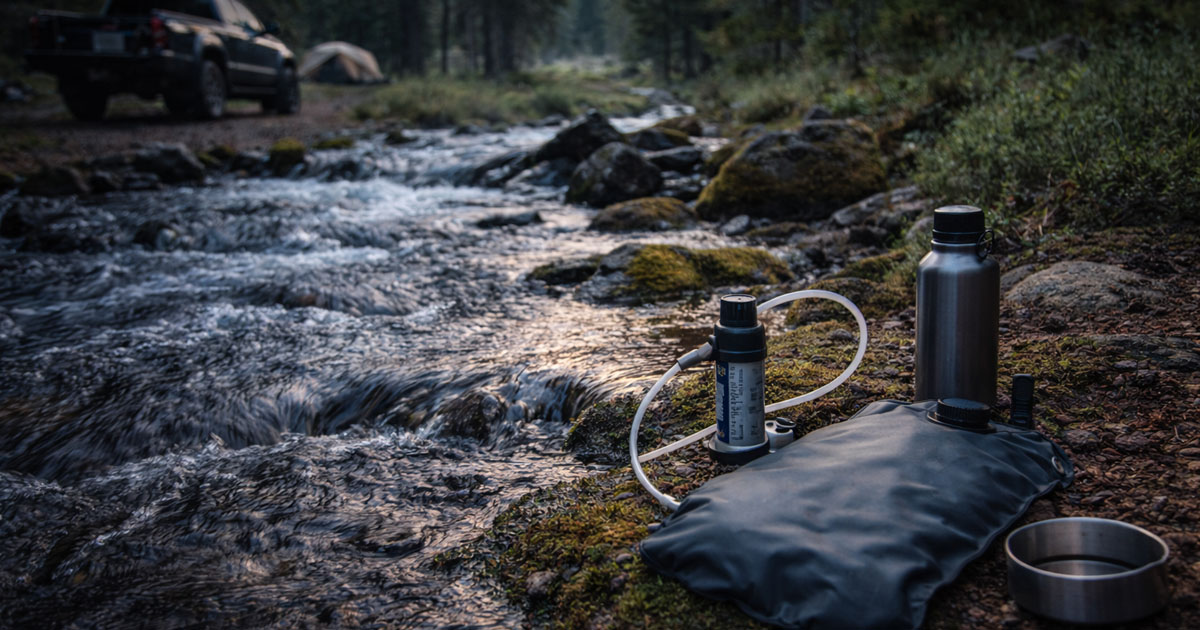
Water is the single biggest logistics problem in dispersed camping. At a developed campground, you walk to the spigot. At a dispersed site, the nearest water might be a creek you need to filter, a gas station 40 miles back, or nothing at all. We’ve made every dispersed camping water mistake there is — underestimated for a desert trip and rationed for two days, over-packed 25 gallons for a weekend next to a creek, forgotten to fill up at the last town before a 70-mile stretch of nothing. Whether you call it dispersed camping or boondocking, water is the skill that separates a comfortable trip from an emergency — and boondocking water management is identical whether you’re in a van, a truck, or a Subaru.
This guide is the complete water system we’ve built from those mistakes. Not just “bring enough water.” The actual math, the containers, the filtration, and the grey water management that most guides pretend doesn’t exist. If you’re new to dispersed camping, start with our complete dispersed camping guide for the full fundamentals. This article goes deep on the water piece.
The Water Math — How Much You Actually Need
The standard advice is 1 gallon per person per day. That’s fine as a baseline for moderate weather in the mountains. It’s not enough for desert heat, and it doesn’t account for everything else you use water for at a dispersed site.
Here’s how much water for camping you actually need, broken down by use:
Drinking and cooking: 1 gallon per person per day in moderate conditions (60–80°F, moderate elevation). In desert heat above 85°F, increase to 1.5–2 gallons. Wind and dry air accelerate dehydration even when you don’t feel yourself sweating — we’ve been surprised by how fast water disappears on a windy day in the San Rafael Swell. Above 7,000 feet, add 25% to your baseline — altitude dehydrates you faster than you’d expect.
Non-drinking uses: Hand washing, dish washing, dog water, and cooling down in heat add up to 0.5–1 gallon per person per day. This is the number most people forget. If you’re cooking fresh food (not freeze-dried), pasta and rice water, pot cleaning, and dish rinsing all pull from your supply.
Fire safety reserve: Keep 5 gallons at the fire ring whenever you have a fire. This is non-negotiable and it’s not part of your drinking supply.
Dog water: If you’re camping with a dog, a 50-pound dog can drink a gallon per day in heat. See our guide on dispersed camping with dogs for the full breakdown.
The reserve: Always carry one extra day’s worth of water beyond your planned trip length. Roads wash out. You get a flat tire 30 miles from pavement. Weather pins you at camp for an extra day. The reserve is not a luxury — it’s the difference between an inconvenience and a rescue call.
Cooking style matters more than people think. Freeze-dried meals use 2 cups of water per meal — that’s it. Fresh food cooking (boiling pasta, making rice, washing vegetables, cleaning pots) can use 2–3 gallons per day for two people. If you’re on a water-limited desert trip, freeze-dried dinners save a meaningful amount of water. We switch to freeze-dried meals on desert trips specifically for this reason.
Camping Water Containers — What We Use and Why
The container system matters more than any individual product. You need primary storage for transport, camp-use containers for convenience, and a filtration backup for longer trips. Here’s our camping water system after four years of refining it.
Rigid Containers (Primary Water)
For camping water storage that survives dirt roads, stacks in a truck bed, and pours without a second person, rigid containers are the standard.
We use two 7-gallon Reliance Aqua-Tainers as our primary supply. They stack vertically, fit in the truck bed without sliding, have a built-in spigot for pouring, and we’ve never had one crack or leak in four years of rough roads. Fourteen gallons covers two people for four days in mountain conditions or two and a half days in the desert.
Other camping water containers worth considering:
- 5-gallon Scepter military water cans: The most durable option. Nearly indestructible. Heavy when full (42 lbs each) but they nest and stack perfectly. No spigot — you pour from the top or add an aftermarket spout.
- WaterBrick stackable containers (3.5 gallons): Smaller, modular, stack like building blocks. Good for fitting water into odd vehicle spaces. More containers to manage.
- 5-gallon round jugs (generic): Cheap, available at any hardware store. They roll around in a truck bed and tip over. Fine as a budget option if you wedge them in place.
Where to fill: Gas stations (ask permission — most are fine with it), campground water spigots (even if you’re not staying — most allow water fills), RV dump stations with fresh water spigots, visitor centers, and municipal water fill stations in many western towns. Moab, Green River, Hanksville, Torrey, Escalante, and Kanab all have accessible water fills. Fill every container at the last town before you leave pavement.
Collapsible Containers (Camp Use)
A collapsible water jug (2–5 gallon) is your camp table water — the container you set out for hand washing, quick drinks, and cooking fills. They don’t transport well when full (they slosh and deform), but they’re lightweight, take no space when empty, and keep you from opening your primary containers every time you need to rinse your hands.
We use a 3-gallon Sea to Summit collapsible jug at camp. It gets filled from the Aqua-Tainers each morning and lives on the camp table all day. When it’s empty, we refill from primary storage. This keeps the Aqua-Tainers sealed and in the shade, which matters for water taste and temperature.
The Full System
Our camping water system for a typical three-day trip (two people, one dog, mountain conditions):
- Primary: 2× Aqua-Tainer 7-gallon (14 gallons total)
- Camp use: 1× collapsible jug 3-gallon (filled from primary)
- Dog: 1× dedicated 2.5-gallon jug
- Fire safety: 1× dedicated 5-gallon jug (stays at the ring)
- Backup: Platypus GravityWorks gravity filter (for creek sourcing on trips longer than 3 days)
- Total capacity: 24.5 gallons / ~203 lbs when full
For desert trips, we add a third Aqua-Tainer and drop the gravity filter (no creeks to filter from). For trips near reliable water, we carry less primary water and plan to filter every other day.
How to Find and Filter Water Near Dispersed Sites
If you’re camping near a creek, river, or spring, you can extend your water supply indefinitely with filtration. This is the bridge between the “bring everything” approach and the “filter everything” backpacking approach — and it’s the part most dispersed camping guides skip.
Finding Water Sources Before Your Trip
Don’t drive to a dispersed site assuming the creek on the map will be flowing. Check before you go.
Topo maps (Gaia GPS, CalTopo, USGS): Blue lines indicate water. Solid blue = perennial stream (flows year-round, usually). Dashed blue = intermittent (seasonal — may be dry in late summer). A solid blue line near your planned dispersed site is a potential filtration source.
USGS WaterWatch: The USGS maintains real-time stream gauges on major waterways across the country. Search for gauges near your area to see current flow data. A gauge reading of zero means the creek is dry. Even a small flow reading means you have a filtration source.
Call the ranger district: This is underrated and free. Rangers know which creeks near dispersed camping areas are currently flowing. A two-minute call before your trip can tell you whether to pack a gravity filter or an extra Aqua-Tainer.
Desert reality: In southern Utah, Arizona, Nevada, and much of New Mexico, there may be no filterable water within 50 miles of your dispersed site. The desert doesn’t have creeks the way mountains do. For desert camping, carry all your water — filtration is not a backup plan. See the desert water section in our guide to dispersed camping in Utah.
Water Filtration for Car Camping
This isn’t backpacking. You don’t need to save ounces. You need to process volume efficiently. Here’s what works for a water filter for car camping and dispersed sites.
Gravity filters — our recommendation:
The Platypus GravityWorks 4L is what we use. Fill the dirty bag at the creek, hang it from a branch or your vehicle’s roof rack, and let gravity push water through the filter into a clean bag. No pumping, no effort. Flow rate is about 1.75 liters per minute — 4 liters in roughly 2.5 minutes. We’ve used it to fill both Aqua-Tainers in under 30 minutes by cycling the dirty bag.
The MSR AutoFlow is similar — slightly different bag design, same gravity principle. Either works. The key advantage over pump filters: you set it up and walk away. No arm fatigue, no sitting at a creek pumping for 20 minutes.
Pump filters: The MSR MiniWorks EX and Katadyn Hiker Pro are proven pump filters. They process water faster per stroke than gravity filters but require constant pumping. Better for filling a water bottle quickly; worse for filling large containers. We keep a Sawyer Squeeze as an ultralight backup in addition to the gravity filter.
Chemical treatment: Aquamira drops and Potable Aqua tablets are lightweight backup options. They take 15–30 minutes to work and treat small volumes (1 liter at a time). We carry Aquamira drops as an emergency backup in case the gravity filter fails. They weigh almost nothing.
The Practical Process
Here’s how we filter water at a dispersed camp near a creek:
- Walk or drive to the water source with the gravity filter’s dirty bag and a backup container.
- Fill the dirty bag from the fastest-flowing section of the creek, away from the banks. Moving water has less sediment and fewer stagnant-water pathogens.
- Back at camp, hang the dirty bag above your clean container (tree branch, roof rack bar, tailgate). Let it flow through the filter.
- Cycle the dirty bag as many times as needed to fill your storage containers.
- Backflush the filter after every session to maintain flow rate.
We’ve done this on trips up to 10 days in Colorado’s national forests, carrying 14 gallons of primary water and filtering from a creek every third day. The gravity filter extends a three-day water supply into a week-plus supply — as long as the creek is flowing.
Grey Water at a Dispersed Site
Grey water camping management is the section nobody writes — and everyone who dispersed camps deals with daily. Grey water is any non-toilet waste water: dish water, hand wash water, cooking liquid, coffee rinse. At home it goes down the drain. At a dispersed site, you’re the drain.
The scatter method:
- Strain it. Pour grey water through a fine mesh strainer or bandana to catch food particles. The food particles go into your trash bag — they attract animals if left on the ground.
- Walk 200 feet from water, camp, and trails. Same distance as human waste.
- Scatter in a wide arc. Broadcast the strained water over a large area so the soil absorbs it. Don’t dump it in one concentrated spot — that creates a grease patch and smell that lasts for weeks.
Reducing grey water volume:
Wipe plates, pots, and utensils with a paper towel before washing. This removes 90% of the food residue and dramatically reduces the water needed for actual washing. Use a small basin with 1–2 cups of water, not a running stream from your jug. Biodegradable soap (Dr. Bronner’s, Campsuds) in small amounts — a few drops is enough.
We generate about 1 gallon of grey water per day for two people. That’s manageable — one trip with the strainer to a broadcast area, 30 seconds of scattering, done. The key is the strainer. Skip it and you’re dumping food chunks on the ground, which attracts rodents and ravens and makes the site worse for the next camper.
Water Mistakes We’ve Made (So You Don’t Have To)
Four years of dispersed camping has taught us more about water through failure than through planning. These dispersed camping tips come from specific mistakes.
Under-packed for a San Rafael Swell trip. We budgeted 1 gallon per person per day for a four-day trip in April. The wind picked up on day two — constant, dry, 25 mph gusts that pulled moisture from us faster than we expected. By day three we were rationing. The nearest water was Hanksville, 45 miles of dirt road away. We cut the trip a day short and drove out with about a gallon left between us. Now we budget 2 gallons per person per day for any desert trip, regardless of season.
Forgot to fill up at the last town. Driving to a Capitol Reef dispersed site, we passed through Torrey with half-full Aqua-Tainers, planning to fill up in Hanksville — which we somehow thought was closer than it is. It’s 50 miles of desert highway with nothing in between. We turned around, lost two hours, and filled up in Torrey. Now we fill every container at the last town with a spigot, regardless of how much water we have.
Relied on a mapped creek that was dry. A solid blue line on the topo map showed a creek a quarter mile from our planned dispersed site in the White River National Forest. We planned to filter from it. It was late August, and the creek was bone dry — just a sandy channel. We had enough reserve water to finish the trip, but the backup filtration plan was useless. Now we check USGS stream gauge data before relying on any creek as a water source.
Left the fire safety water in the truck. We kept our 5-gallon fire safety jug in the truck bed, 50 yards from the fire ring. A small ember popped out of the ring onto dry grass. Caught it fast, but we had to sprint to the truck for water. Now the dedicated fire safety jug sits at the ring whenever we have a fire burning. Not in the truck. Not at the camp table. At the ring.
The Bottom Line
Water is weight, water is planning, and water is the difference between a comfortable dispersed camping trip and an emergency. The system matters more than any single container or filter — know how much you need (be honest about conditions and usage), carry it in rigid containers that survive dirt roads, have a filtration backup near reliable water, and manage your grey water like the LNT-conscious camper you are.
If you’re heading out this weekend: fill two 7-gallon containers at the last town, bring a collapsible jug for camp, and carry a gallon more than you think you need. That’s 90% of the water problem solved. The filtration and grey water pieces come with experience — start with carrying enough and build from there.
Frequently Asked Questions
How much water do you need for dispersed camping?
The baseline is 1 gallon per person per day for drinking and cooking. In desert heat above 85°F, increase to 1.5–2 gallons. Add 0.5–1 gallon per person for non-drinking uses (dishes, hand washing, fire safety). Always carry one extra day’s reserve. For a two-person, three-day desert trip, plan on roughly 20–24 gallons.
How do you store water when camping?
Rigid containers like 7-gallon Aqua-Tainers or 5-gallon Scepter water cans are the standard for dispersed camping. They stack in a vehicle, don’t puncture on rough roads, and pour without help. Add a collapsible jug for camp use and a dedicated container for fire safety water. Keep containers in shade to prevent plastic taste and algae growth.
Can you filter water when dispersed camping?
Yes, if you’re near a reliable creek or river. Gravity filters like the Platypus GravityWorks are the best option — they process large volumes without pumping. Don’t filter from standing water near cattle grazing, below mining operations, or from algae-covered sources. In desert areas, there may be no filterable water for 50+ miles — carry all your water instead.
What is the best water container for camping?
For dispersed car camping, the 7-gallon Reliance Aqua-Tainer is our pick. It stacks, has a built-in spigot, and survives rough roads. The 5-gallon Scepter military can is more durable but heavier and lacks a spigot. WaterBrick stackable containers work for tight vehicle spaces. Avoid round jugs that roll around in transit.
How do you dispose of grey water when camping?
Strain grey water through a fine mesh or bandana to catch food particles — pack those out with your trash. Scatter the strained water in a wide arc at least 200 feet from any water source, trail, or camp. Use biodegradable soap in small amounts. Never dump grey water near creeks or in one concentrated spot.
How do you find water sources when camping?
Check topographic maps (Gaia GPS, CalTopo) for blue lines — solid blue means perennial, dashed blue means intermittent and may be dry seasonally. USGS WaterWatch shows real-time stream flow data. Call the local ranger district for current creek conditions. In desert areas, plan on no filterable water and carry everything you need.