Boondocking for Beginners: Your Complete First-Trip Guide
Boondocking for beginners — how to camp free on public land, find spots, pack the right gear, and avoid first-timer mistakes. No RV required.
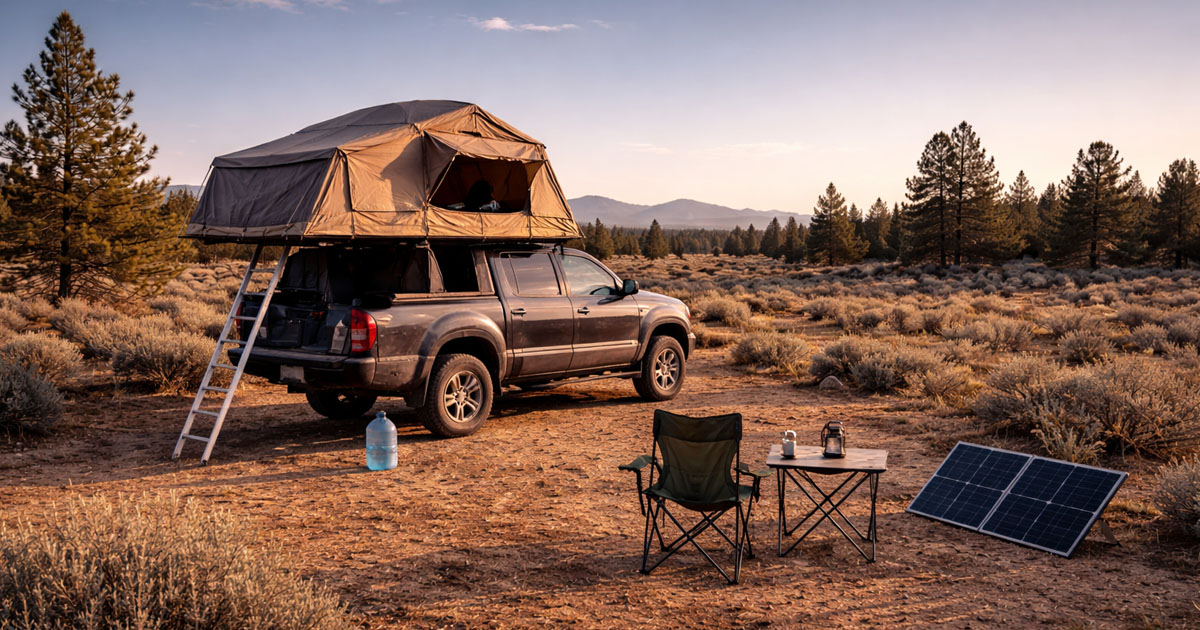
You’ve seen the photos — someone camped on a wide-open stretch of public land, no campground sign, no hookups, no fee station, no other people. You want to try it. But the logistics feel like a wall. Where is it legal? How do you find a spot? What happens if something goes wrong? Boondocking for beginners can feel harder than it actually is. The rules are simpler than campground reservations, the gear list is shorter than you think, and the worst first-trip mistake is overthinking it. This guide walks you through everything you need for your first boondocking trip — whether you’re in an RV, a van, a truck, or a sedan with the back seat folded down.
What Is Boondocking?
Boondocking is camping on public land without hookups, facilities, or fees. No water spigot, no electrical hookup, no camp host, no designated pad. You bring everything you need and leave nothing behind.
If you’ve heard the term “dispersed camping,” it’s the same thing. The RV, van life, and overlanding communities say “boondocking.” The U.S. Forest Service and Bureau of Land Management say “dispersed camping.” Same activity, different audiences, different search results. If you search “boondocking,” you’ll find van life content. Search “dispersed camping,” and you’ll find backpacking guides. Both are talking about the same kind of camping.
It’s legal on most Bureau of Land Management and National Forest land across the western United States. It’s generally not legal in national parks (with rare backcountry permit exceptions), most state parks, or on private land without permission. The rules are straightforward once you know which land you’re on — and we cover all of them in our complete dispersed camping guide.
Where Can You Boondock for Free?
Two types of public land account for the vast majority of free camping in the United States. Both are managed by the federal government, both are free, and both have a 14-day stay limit.
BLM Land
The Bureau of Land Management oversees 245 million acres, mostly across the western states — Utah, Nevada, Arizona, New Mexico, Colorado, Wyoming, Montana, Idaho, Oregon, California. Most of that land is open to boondocking. The rules are simple: 14-day stay limit within a 28-day period (meaning you can’t just move 50 feet and restart the clock), camp on previously disturbed ground, and stay at least 25 feet from water sources. Some areas near national parks or wilderness areas have specific restrictions — check with the local BLM field office before your trip.
BLM land tends to be open desert, grassland, or high-desert terrain. It’s often flat, easy to access, and has obvious pull-offs where others have camped before. The quality of free camping on public land in the West is largely a BLM story.
National Forest Land
The U.S. Forest Service manages 193 million acres across 154 national forests. Dispersed camping is allowed unless posted otherwise. The 14-day stay limit applies here too. The key document is the Motor Vehicle Use Map (MVUM), which shows which roads are open to vehicles and where dispersed camping corridors exist. Camp 100–200 feet from water, trailheads, and developed campgrounds (the exact distance varies by forest).
National forest land tends to be more wooded, higher elevation, and sometimes more regulated than BLM land. Forest roads can be rougher and seasonal closures are common. But the camping is often more scenic and more shaded.
Where You Can’t Boondock
National parks — no dispersed camping, period. Most state parks. Private land without the owner’s permission. Developed campgrounds without paying the fee. Wilderness areas (no motorized access, so you can backpack in but not drive). When in doubt, check land ownership with a public land app like Gaia GPS or onX. If the map shows white space (private land) instead of green or yellow (public land), keep driving.
How to Find Boondocking Spots
Knowing where boondocking is legal and actually finding a specific spot are two different problems. Here’s the process for finding a place to camp before and during your trip.
Start with the MVUM. For national forests, this is the most important tool. The Motor Vehicle Use Map shows which roads are open to motor vehicles and where dispersed camping is permitted along those roads. It’s free to download from the USFS website — search “[forest name] Motor Vehicle Use Map.” Print it or save it to your phone. Cell signal isn’t guaranteed where you’re going.
Use the apps. iOverlander has the largest database of user-reported boondocking spots, with photos, GPS coordinates, and recent reviews. Campendium is RV-focused. FreeRoam has a clean public land overlay that shows BLM and USFS boundaries. Gaia GPS shows public land ownership layers — the one you need for verifying that an iOverlander pin is actually on public land and not on someone’s ranch.
Cross-reference everything. This is the key beginner skill: never trust a single app pin. An iOverlander spot might be on private land. A Campendium review might be three years old and the road is now gated. Verify land ownership against a public land layer. Check recent reviews for current conditions — road access, availability, gate status.
Plan backups. Always identify 2–3 alternative sites before your trip. Popular boondocking spots fill up, especially on weekends and during peak season. If you roll up to your first choice at 4 PM and it’s occupied, you need a Plan B that doesn’t involve driving an hour in fading daylight.
For the full step-by-step workflow — including how to read MVUMs and cross-reference apps — see how to find dispersed camping sites.
Boondocking Gear — What You Actually Need
One of the biggest misconceptions about boondocking is that you need an expensive setup. You don’t. You need the right essentials and a vehicle — any vehicle. Here’s the gear list organized by what matters.
The Non-Negotiables
Water. This is the most important thing you carry. One gallon per person per day minimum — and that’s conservative if you’re cooking, cleaning, and camping in heat. Bring rigid containers (collapsible bags work as backup but puncture and leak). Fill everything at the last town before you leave pavement. For a full breakdown of boondocking water systems — containers, filtration, and how much you actually use — see our dispersed camping water guide.
Waste management. You are the sewage system. For solid human waste: WAG bags (commercially available waste kits) or a trowel for digging cat holes (6–8 inches deep, 200 feet from water, trails, and camp). Toilet paper goes in a ziplock bag and gets packed out — do not bury it, do not burn it. Heavy-duty trash bags for all other garbage. Everything you bring in leaves with you.
Shelter. Whatever you sleep in works. Tent, truck bed with a topper, SUV with the seats folded, van, RV. There’s no minimum entry requirement. Some of the best boondocking we’ve done was in a sedan with a sleeping pad in the back.
Fire safety. If fires are allowed — and you need to check restrictions before you go — keep a shovel and 5 gallons of water at the fire ring. If fires aren’t allowed, don’t have one. It’s not negotiable.
Communication. A satellite communicator (Garmin inReach, Zoleo, or SPOT) if you’re going beyond cell range. This isn’t about comfort — it’s about being able to call for help if your vehicle breaks down on a forest road 20 miles from the nearest highway. For trips within cell range, your phone is fine.
Paper MVUM map. Phones die. Apps crash. Cell signal vanishes. A printed Motor Vehicle Use Map doesn’t need a battery.
Nice to Have
- Camp stove — some areas ban campfires year-round, and even where fires are allowed, a stove is faster and easier
- Headlamp with fresh batteries — it gets dark out here, and “where’s the headlamp” is not a question you want to answer at midnight
- Leveling blocks or boards — dispersed sites aren’t flat like campground pads. A couple of boards under one side of your vehicle makes sleeping dramatically better
- Collapsible camp chair and table — you can sit on the ground, but after the first trip you’ll bring a chair
- Basic tool kit and tire plug kit — rough roads and sharp rocks are part of the deal
- For longer trips: a portable power station with a solar panel. See best power stations for dispersed camping for what we tested
Your First Boondocking Trip — Step by Step
This is the section you can use as a checklist. It walks through the actual sequence from planning to driving home.
Before You Go
Pick a location within 2 hours of home for your first trip. This isn’t the time for a remote backcountry adventure — it’s the time to learn the process in a low-stakes setting. Close to home means you can bail if something goes wrong, and you won’t burn half your water on the drive.
Download the MVUM for your chosen area. Cross-reference app pins (iOverlander, FreeRoam) against public land layers (Gaia GPS, onX). Confirm the land is public and the road is open.
Check fire restrictions. This takes two minutes on the USFS or BLM website and it matters.
Pack your gear. Use the list above. Fill all water containers at the last town before you leave pavement — this is the single most important logistical step.
Tell someone where you’re going and when you’ll be back. Leave a written plan: the forest or BLM area name, the road numbers, your expected campsite GPS coordinates, and your return date.
When You Arrive
Look for existing fire rings, cleared areas, and established pull-offs — these are your “sites.” Dispersed camping doesn’t have numbered pads. It has places where people have clearly camped before, and those are the places you should camp. Using existing sites prevents new ground disturbance.
Check five things before you commit to a spot:
- Flat ground — or flat enough that leveling boards can handle the slope
- Not in a wash — dry creek beds and low spots flash flood, even when the sky above you is clear
- 200+ feet from water — streams, springs, lakes, any water source
- Cell signal status — know whether you have it or not, and plan accordingly
- Shade assessment — in summer, afternoon shade is the difference between a good trip and a miserable one
If your preferred spot is taken, don’t panic. Go to your backup. This is why you planned alternatives.
Arrive at least 2 hours before sunset. Setting up in the dark on unfamiliar ground is one of the most common beginner mistakes. Give yourself daylight to find your spot, set up camp, and get oriented.
While You’re There
Manage your water. You brought a fixed supply and there’s no tap to refill from. Track what you’re using — you’ll be surprised how fast a gallon goes when you’re cooking, washing hands, and drinking in dry air.
Keep food in your vehicle overnight, not in your tent or around your campsite. This applies everywhere, not just bear country. Rodents, coyotes, and raccoons are persistent and creative. A cooler in the cab with the windows up is the baseline.
Use the existing fire ring if fires are allowed. Never build a new one — fire scar proliferation is one of the reasons land managers close areas to dispersed camping. If no fire ring exists at your site, use your camp stove.
Pack out everything. Food scraps. Toilet paper. All trash. Micro-trash too — the twist tie from the bread bag, the pull tab from the can, the dryer sheet that blew out of your bag. If it wasn’t there when you arrived, it leaves when you leave.
Breaking Camp
Walk the entire site before you drive away. Pick up micro-trash, even if it’s not yours. This is the standard — you leave the site better than you found it.
If you had a fire: stir the ashes, douse with water, stir again, feel with the back of your hand. If it’s hot, repeat. Cold ashes don’t start wildfires.
Scatter grey water (dish water, hand-washing water) at least 200 feet from any water source and 200 feet from your campsite. Strain it through a mesh bag first to catch food particles — those go in the trash.
Leave it better than you found it. That’s the whole philosophy. For the full breakdown of leave no trace practices for dispersed camping, see our dispersed camping leave no trace guide.
Boondocking Etiquette — The Unwritten Rules
These aren’t posted on signs. They’re the social norms that keep boondocking working for everyone.
Give space. 300+ feet from other campers if terrain allows. People boondock for solitude. Don’t park 50 feet from someone else’s camp when there’s an entire desert available.
Generator hours. Daytime only — and even then, keep it short. People came out here to get away from engine noise. If you’re running a generator at 10 PM, you’re the reason someone leaves a bad review on iOverlander.
Dogs under control. Off-leash only if your dog is under genuine voice command and no one else is nearby. “He’s friendly” is not a leash.
Volume. Sound carries without buildings, trees, and traffic to absorb it. What’s normal volume at home dominates a canyon. Music through a speaker, car doors slamming, conversations at full volume — all of it travels farther than you think.
The real rule: leave no trace. If everyone left one clean site, these places stay open. If they don’t, land managers close them — and it’s already happening. Trash, fire scars, human waste, and illegal off-road driving are the reasons public land gets shut down to dispersed camping. Every clean site you leave is a vote to keep these places accessible.
Common Beginner Mistakes (and How to Avoid Them)
These are the mistakes we’ve made, watched others make, and heard about repeatedly — and they’re the most practical boondocking tips we can offer. All of them are avoidable.
Arriving after dark with no backup site. You can’t evaluate a campsite you can’t see, and you can’t find your backup if you don’t know where it is. Arrive with daylight. Have alternatives planned.
Not bringing enough water. The most common boondocking mistake, by a wide margin. You always use more than you estimate. A gallon per person per day is the floor, not the target. In desert heat, plan for 1.5–2 gallons. And fill up at the last town — not “somewhere along the way.”
Trusting a single GPS pin without verifying land ownership. An iOverlander pin says “great spot, camped here last June.” The public land layer shows it’s private property. This happens constantly. Cross-reference every spot against a land ownership map before you drive in.
Camping in a wash or dry creek bed. It looks flat, sheltered, and inviting. It’s a flood channel. Read the ground — debris lines, smooth-washed rocks, sandy channels. Camp on higher ground.
Leaving food scraps or toilet paper at the site. Both attract wildlife and both are why sites get closed. Pack out all food waste and all toilet paper. No exceptions.
Underestimating how dark it gets. No streetlights, no ambient glow, no porch light from the neighbors. Boondocking dark is an order of magnitude beyond suburb dark. Have your headlamp accessible — not buried in a bag — and keep it within arm’s reach when you sleep.
Overthinking it. This is the biggest one. Your first boondocking trip doesn’t need to be five days in the backcountry with a perfectly dialed gear setup. One night. Close to town. Within cell range. Enough water, a place to sleep, and a bag for your trash. That’s the starter trip. Everything else — the perfect spot, the solar-powered kitchen, the three-week off-grid rotation — comes with experience. Start simple. Go once. You’ll know what you need to change for trip two.
The Bottom Line
Boondocking is simpler than it seems from the outside. The rules are straightforward — 14-day limit, camp on disturbed ground, stay away from water, pack everything out. The gear list is short. The learning curve is exactly one trip. Most of the anxiety is about the unknown, and the unknown disappears the moment you spend one night on public land and realize how manageable it is.
Start close to home. Bring more water than you think you need. Follow leave no trace. Leave a clean site behind. That’s the entire framework. Pick a national forest or BLM area within two hours of where you live, download the MVUM, fill your water containers, and go for one night. That’s your first boondocking trip. Everything after that is refinement.
Frequently Asked Questions
What is boondocking?
Boondocking is camping on public land without hookups, facilities, or fees. It’s the same activity as dispersed camping — “boondocking” is the term used by the RV, van life, and overlanding communities, while “dispersed camping” is the term used by the U.S. Forest Service and BLM. It’s legal on most BLM and National Forest land with a 14-day stay limit.
Is boondocking legal?
Yes, on most Bureau of Land Management and National Forest land in the United States. It’s generally not legal in national parks, most state parks, or on private land without permission. Rules vary by area — check with the local ranger district or BLM field office before your trip. The 14-day stay limit applies on both BLM and USFS land.
Where can you boondock for free?
Most BLM land (245 million acres) and National Forest land (193 million acres) across the western states allow free boondocking. Use apps like iOverlander, FreeRoam, and Gaia GPS to find spots, and always verify land ownership with a public land layer before driving in. Some areas near national parks have specific restrictions.
What do you need for boondocking?
At minimum: all your water (1 gallon per person per day), waste management supplies (WAG bags or trowel, ziplock bags for toilet paper, trash bags), shelter, fire safety tools, and a headlamp. A satellite communicator is strongly recommended for remote areas. You don’t need an RV — any vehicle works.
How do you find boondocking spots?
Start with the USFS Motor Vehicle Use Map for national forests. Use apps like iOverlander, Campendium, and FreeRoam for user-reported spots. Always verify land ownership with Gaia GPS or onX before driving in. Have 2–3 backup locations planned in case your first choice is taken.
Is boondocking safe?
Yes, with basic preparation. The main risks are logistical, not criminal — running low on water, getting stuck on a rough road, or not being reachable in an emergency. Mitigate by starting close to home, staying within cell range on your first trips, telling someone your plan, carrying a satellite communicator, and bringing more water than you think you need.